FeatureBeliz Aytekin7 min read
Yello built songs from parts, and the world took them apart. Time Lab does it to itself
Out today, Yello's 15th album reuses a vocal cut in 1981. Clubs, Hollywood and a Tijuana dentist borrowed Yello's parts for 45 years. Now the band does too.
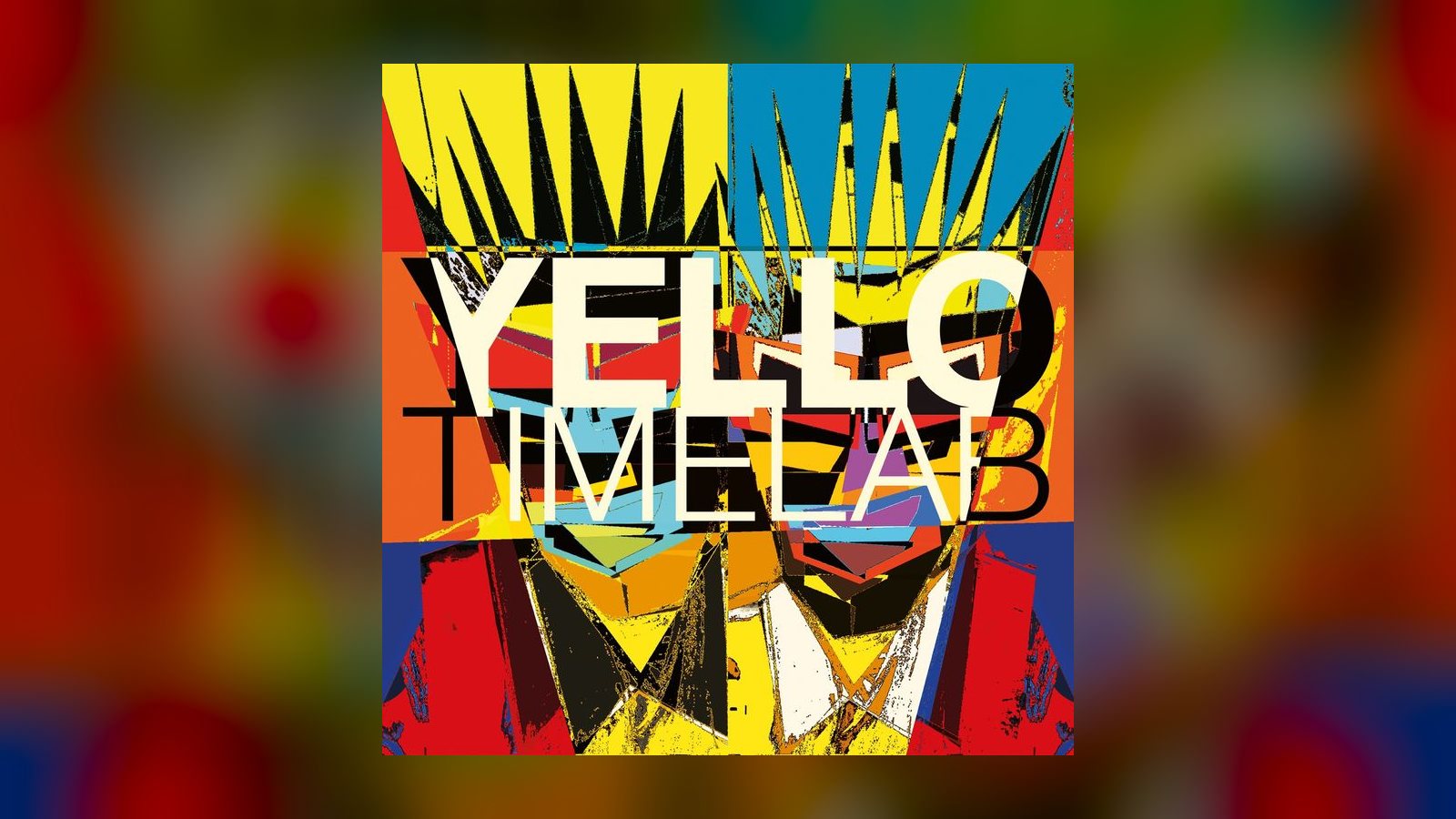
Artwork: Polydor
In 1972, at documenta 5 in Kassel, a young Zurich artist called Dieter Meier fixed a plaque to the ground at the railway station. It announced that on 23 March 1994, from 3 to 4 pm, Dieter Meier would stand on this plaque. Twenty-two years later, he turned up and stood on it.
That is the right way into Time Lab, the 15th Yello album, out today on Polydor. Its first single, "Around the Sun", is built on a Meier vocal recorded for the band's second album, Claro Que Si, and dropped at the last minute before that record came out in 1981. Boris Blank, the other half of Yello, gave the 45-year-old voice a new rhythm track. Meier's line for the album, printed in the label's own notes, is "To the future, through the past."
Here is ADMC's reading of the through-line. Yello never belonged to a scene, so they never made records that a scene could own. They made records out of parts: a sound, a vocal tic, a percussion loop, a word. And that is exactly how their music travelled. American dance floors took a groove, Hollywood took a two-word hook, a dentist in Tijuana took a song title for his own name. Time Lab is Yello openly doing the same thing to Yello.
Two outsiders and a tape machine
Yello formed in Zurich in 1979, when Blank and Carlos Perón went looking for a singer and found Meier. Perón left in 1983, and it has been a duo ever since. Meier, born in Zurich in 1945, had dropped out of law school, gambled professionally and made conceptual art. Blank, born in Bern in 1952, drove trucks. The band's own biography is blunt about him: "He never learned to play an instrument or read music."
What he did have was tape. As a teenager he recorded water and echoes onto loops, and the official biography notes that "When Yello started recording, the sampler had not even been invented." By the time it had, he was ready: the 1985 recording of "Oh Yeah" lists him on a Fairlight CMI, one of the first digital samplers, next to a glass harp played by Petia Kaufman. A Yello track was assembled, not composed. Blank built the bed from sounds he had caught and filed. Meier walked in and found a character to play on top.
That method matters more than any single song, because it produced music with seams. You can lift one piece out of a Yello record and it still works on its own. Europe's other electronic through-lines ran through scenes, from Manchester's synth pop to Belgium's new beat. Yello's ran through the parts.
Bostich, or how a groove crossed the Atlantic
The first piece to go was "Bostich". It sat on the debut album Solid Pleasure, released in October 1980 and put out in the United States by Ralph, the San Francisco label run around The Residents. A longer version came out as a single in 1981. It never touched the pop charts in America. It reached No. 23 on Billboard's dance club chart, which tells you where it lived: in DJ crates, as a rhythm and a chant rather than a song anyone sang along to.
Listen to it now and the logic is obvious. Meier half raps a string of near nonsense over a sequenced bassline and machine percussion, and the whole thing is designed to loop. It sounds less like a single than like a tool. Dance producers treated it like one for decades. When Yello's catalogue was handed to remixers in 1995 for Hands on Yello, Berlin's WestBam took "Bostich", and the roster around him included Moby, The Orb, Jam & Spoon, Carl Cox and the Detroit producer Carl Craig. That is a list of people from three different dance cultures, all treating a Swiss art project as raw material.
The same seams made Yello a hit in Britain. "The Race", from 1988, is a car chase built from sampled percussion and racing noise, and it went to No. 7 in the UK, the band's only top 10 there. A year earlier, "The Rhythm Divine" had put Shirley Bassey's voice inside one of Blank's sound beds, which is about as clear a statement of the method as exists: the biggest voice in the room becomes one more part.
Oh Yeah, for rent
Then there is "Oh Yeah". It came out in 1985 on Stella, reached No. 51 on the Billboard Hot 100, and remains Yello's only entry on that chart. Its real life began in a cinema. Ferris Bueller's Day Off used it in 1986 for Cameron's father's Ferrari, The Secret of My Success leaned on it a year later, and by the end of the decade it was the film industry's shorthand for wanting things: cars, money, someone across the room.
It is the purest case of a Yello part going out into the world without the band. Nobody needs the whole song. They need the bass drop and two words in that low, slow voice. The Simpsons gave it to Duffman, the beer mascot. Honda paid for it in 2012, when Matthew Broderick replayed Ferris in a Super Bowl commercial. A 2006 rework, "Oh Yeah 'Oh Six", went to No. 1 on the US dance club chart, two decades after the original stalled at No. 51. In June 2025 a 17-minute documentary about the song alone, Oh Yeah!, directed by Nick Canfield, premiered at the Tribeca Festival.
Blank has since worked that market directly. Since 2012 he has released instrumental volumes under the name Avant Garden through Extreme Music, a library that licenses music to film and television. The man who built Yello from catalogued fragments now writes catalogued fragments for other people's scenes.
A dentist in Tijuana takes the name
The most surprising afterlife is more than 9,500 kilometres from Zurich. In the late 1980s Ramón Amezcua, a dentist and orthodontist in Tijuana, was making electronic tracks for a friend's avant-garde radio show. Asked on the spot what he would call himself, he took the title of a Yello song. He has been Bostich ever since.
What Amezcua did next is one of the most faithful versions of the Yello method anyone has made, even though it sounds nothing like Yello. With Pepe Mogt and others he founded Nortec Collective in 1999, and they built tracks from recordings of norteño music, the accordion and tuba sound of northern Mexico's dance halls, cut up and set over drum machines. His track "Polaris" became the scene's starting point. Mexico's federal government chose it as an official song for its millennium celebrations in 2000, and Bostich and Fussible's Tijuana Sound Machine was later nominated for a Grammy.
Yello took the sounds Blank caught on tape and filed them as parts. Nortec took the sounds of Tijuana's border culture and did the same. The name on the record is not a tribute so much as a job description.
The archive becomes the instrument
For most of their career Yello did not play live. The first proper concerts came in October 2016, four sold-out nights at Kraftwerk, a disused power station in Berlin, 37 years after the band began. At home, both Toy (2016) and Point (2020) went to No. 1 on the Swiss album chart. In 2022 the Swiss Federal Office of Culture gave the duo its Grand Prix for Music, worth CHF 100,000, citing their originality and their decisive influence on electronic music.
Time Lab is what you would expect a band in that position to make, and also something new. According to the label's notes, Blank built it from freshly recorded samples and a deep dip into an archive of riffs, motifs and abandoned song fragments collected over nearly 50 years. "Break Out" uses a bass figure and percussion that the label traces back to the band's early records. Two tracks feature Heidi Happy, the Swiss singer, and one features Malia, who made a whole album with Blank in 2014. The quote Polydor gives Blank for the record is a fair summary of the whole career: "Yello doesn't really know the meaning of time."
What the through-line shows
Most bands' influence travels as a sound people imitate. Yello's travelled as objects people picked up: a groove on a dance floor, a cue in a film, a name in Tijuana. That is why their influence is easy to underrate. You rarely hear a record that sounds like Yello. You hear records that have a bit of Yello inside them, doing a job.
Time Lab turns that around. Meier stood on his plaque in 1994 because he had promised to in 1972. "Around the Sun" is a 1981 promise kept the same way, with Blank treating his partner's young voice exactly as the world has treated Yello: as a part, ready to be used again.
Share this story