FeatureSam Grizelj7 min read
Pet Shop Boys' Turing album is the end of a line that started with a hooter in Manchester
A man from the future is out today. The machine Turing helped teach to sing in 1951 became the instrument British pop's gay men used to say what he could not.
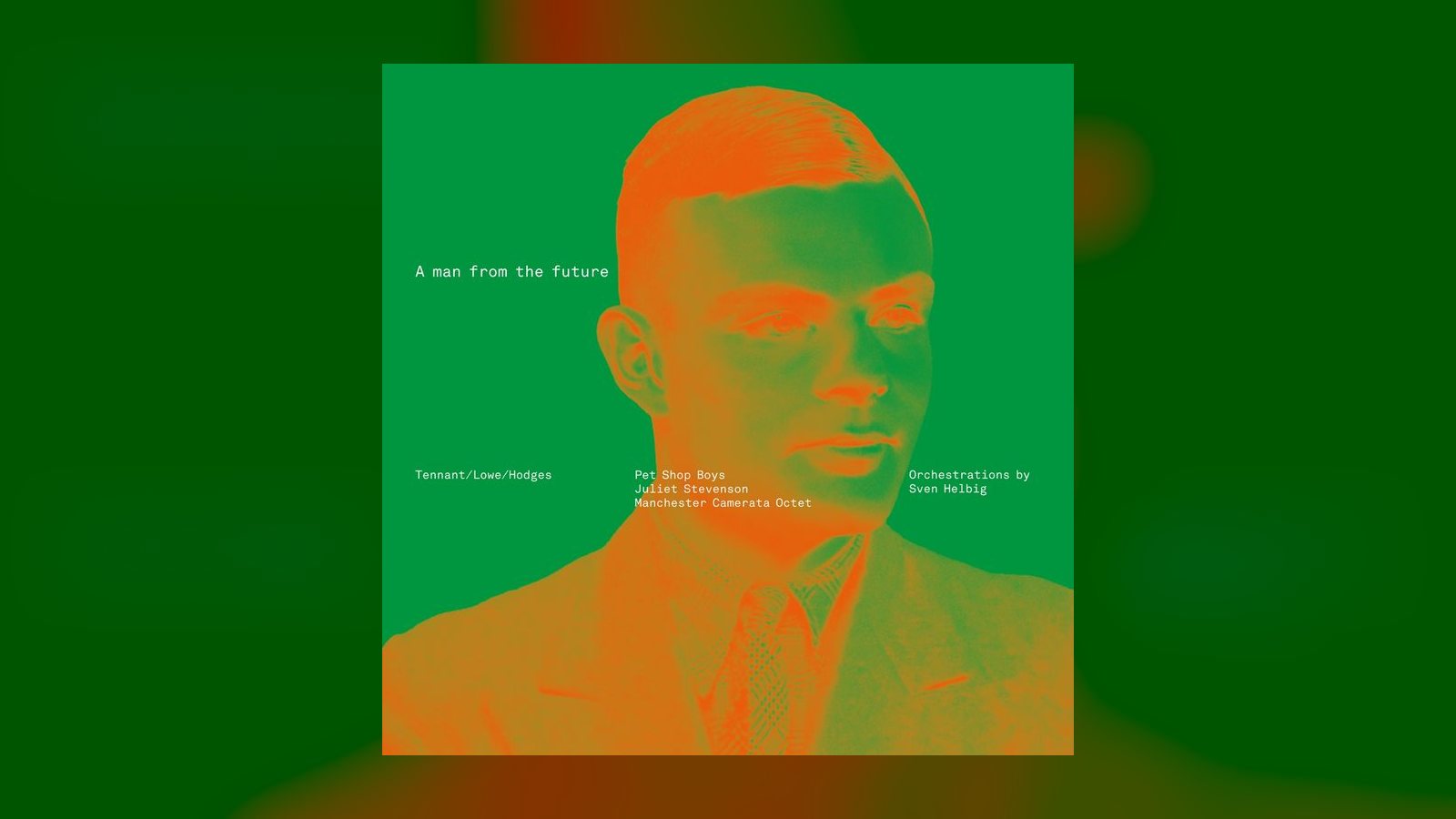
Artwork: Parlophone Records Limited, x2 Recordings Limited
In the autumn of 1951, a BBC outside broadcast team carried its recording gear into the computing laboratory at the University of Manchester. The machine they had come to record was the Ferranti Mark 1, and the sound it made came from a loudspeaker its engineers called the hooter. It played "God Save the King", stumbled halfway through "Baa Baa Black Sheep" and gave up partway into Glenn Miller's "In the Mood". It is the oldest surviving recording of music made by a computer.
The man who had written the machine's programming manual, and the instruction that made the hooter sound, was Alan Turing. A few months later, on 31 March 1952, he stood in a court at Knutsford, a few miles south of Manchester, and was convicted of gross indecency for a relationship with another man.
Today, 9 October 2026, Pet Shop Boys release A man from the future, an eight-part album about Turing's life and death, made with his biographer Andrew Hodges and narrated by the actor Juliet Stevenson. It began life as a commission for the BBC Proms in 2014 and has been rebuilt with more electronics for this release. Read it as a single record and it is a thoughtful tribute. Read it as the end of a through-line and it says something bigger: the machine Turing helped teach to make sound became, three decades later, the instrument British pop's gay men used to say out loud what the law had made him hide. Pet Shop Boys are the clearest proof of that, and this album is them pointing back at where it began.
The hooter and the man who wrote the manual
The facts of 1951 are oddly musical. The Mark 1 had an instruction its programmers called "hoot", which sent a pulse to the speaker, normally to tell an operator a job had finished. Turing described it in the handbook he wrote for the machine, and pointed out that by repeating the pulse at the right rate you could hold a note. Christopher Strachey, then a schoolteacher, used that handbook to write a draughts program that ended by playing the national anthem, and was then talked into writing a routine that could play any tune.
The BBC kept no master. A single acetate disc cut for one of the Ferranti engineers, Frank Cooper, found its way to the National Sound Archive and resurfaced in 2008, when the University of Manchester was preparing to mark 60 years since its first stored-program computer ran in June 1948. Even then, the recording ran at the wrong speed. In 2016, Jack Copeland and Jason Long at the University of Canterbury in New Zealand worked out from the machine's documentation what frequencies it should have produced, corrected the pitch and the wobble, and published the restored sound through the British Library. It sounds like electronic bagpipes. It is also, unmistakably, a machine playing a pop song.
Pet Shop Boys clearly know this history. The fifth track on the new album is called "The memory and the control", two of the core parts of any stored-program computer. The second is "He dreamed of machines". The first, "Natural wonders every child should know", takes its title from the children's science book Turing was given as a boy, which in Hodges's telling first opened his eyes to science, and which describes the human body as a machine.
Thirty years later, the machine learns to confess
Turing accepted a year of oestrogen injections rather than prison, lost his security clearance and died in June 1954, aged 41. Sex between men in England and Wales stayed illegal until 1967, and even after that the law treated it as something to be tolerated in private rather than sung about on television.
Then synthesizers got cheap. By the early 1980s, a drum machine and a keyboard could fill a room the way a rock band used to, and some of the people who seized on them were young gay men from small towns. In 1984, Bronski Beat released "Smalltown Boy", a song about a boy leaving home after his family turns on him, with Jimmy Somerville's falsetto floating over a cold, pulsing synth line. It reached number three in the UK. The inner sleeve of their debut album, The Age of Consent, printed the age of consent for sex between men in countries around the world, at a time when Britain's was 21 against 16 for everyone else.
The sound mattered as much as the words. Rock in Britain still carried a certain idea of a man: the sweat, the guitar, the swagger. Electronic pop took the body out of the instrument and put the voice in front. It let a singer be tender, arch, sad or camp without the band behind him needing to perform anything at all. The machine, which does not care who you love, turned out to be the most honest accompanist going.
Pet Shop Boys, the ones who stayed
Neil Tennant and Chris Lowe met in a hi-fi shop on the King's Road in London in 1981. "West End Girls" went to number one in Britain in January 1986 and in the United States that May. "It's a Sin", their second UK number one in the summer of 1987, set a Catholic boyhood's guilt to Lowe's grand, thunderous synths, and its video was directed by Derek Jarman, the filmmaker who later wrote openly about living with HIV and died of AIDS in 1994.
The next year, Margaret Thatcher's government passed Section 28, which banned local authorities in England, Wales and Scotland, including in the schools they ran, from "promoting" homosexuality. It was not repealed in England and Wales until 2003. That is the Britain in which Pet Shop Boys, Erasure (Vince Clarke and Andy Bell, together since 1985) and Bronski Beat were having their biggest hits, and in which a song like "It's a Sin" could be heard at once as a disco record, a confession and a protest. Tennant came out publicly in 1994. By then, the songs had been doing it for him for years.
What separates Pet Shop Boys from their peers is duration. Bronski Beat lost Somerville in 1985. Soft Cell, whose 1981 synth cover of "Tainted Love" topped the UK chart, split in 1984. Pet Shop Boys never stopped. Erasure are still going too: they have just announced Radio!! Radio!!, their 20th album. Forty years on, the two duos are proof that the machine sound was not a fad of one decade but a language that outlived the laws it was answering.
Forward: from the BRITs to the debate over AI
The line runs on. In January 2021, Russell T Davies named his Channel 4 drama about young gay men in London during the AIDS crisis It's a Sin, with Olly Alexander of Years & Years in the lead. Four months later, Alexander and Elton John performed the song at the BRIT Awards and released it as a single for the Elton John AIDS Foundation. A song written in 1987 about guilt was being sung by a generation for whom it was history, and it still fit.
The state has come round, slowly. Gordon Brown apologised for Turing's treatment as prime minister in September 2009. The Queen granted him a royal pardon on 24 December 2013. The so-called Turing law, in force from 31 January 2017, pardoned thousands of other men convicted under the same laws. Since June 2021, his face has been on the Bank of England's £50 note. And since 2001, a bronze of him has sat on a bench in Sackville Gardens in Manchester, a few steps from Canal Street, the heart of the city's gay village. Pet Shop Boys recorded the album's strings with the Manchester Camerata Octet and its boys' choir parts with the Manchester Grammar School choir, both at the Stoller Hall, and launched it with a listening event at the Imperial War Museum North in the city on 8 October. The record went home.
Then there is the question Turing asked in 1950, in a paper that began by wondering whether machines can think and proposed what he called the imitation game. Music is now living inside that question. This month alone, ADMC has reported on a man jailed for an $8 million AI streaming fraud and on Sony Music asking platforms to take down more than 260,000 AI deepfake tracks. The fear in both stories is the same: a machine that imitates a person well enough that nobody can tell.
The through-line from Manchester says something useful about that fear. For 75 years, the most moving British machine music has not been the music a computer made on its own. The hooter in 1951 played other people's tunes. The synthesizers of 1984 and 1987 were in the hands of men who had something urgent to say and found that a machine let them say it more plainly than a guitar would. The point was never whether the machine could pass for human. It was which humans it let speak.
That is why the record's title cuts both ways. Turing was a man from the future in the obvious sense, imagining computers and thinking machines before most people had seen one. But Pet Shop Boys have spent forty years in the future he made possible, using his machines to sing about the life he was punished for. A man from the future is them handing it back to him.
Share this story