FeatureJane Shostak7 min read
Big Pimpin' runs on a 1957 Cairo love song, and US law gave its composer's family no say
Jay-Z plays the Super Bowl in February. His biggest crossover loops Abdel Halim Hafez's Khosara, and a court settled who gets paid, not who speaks for it.
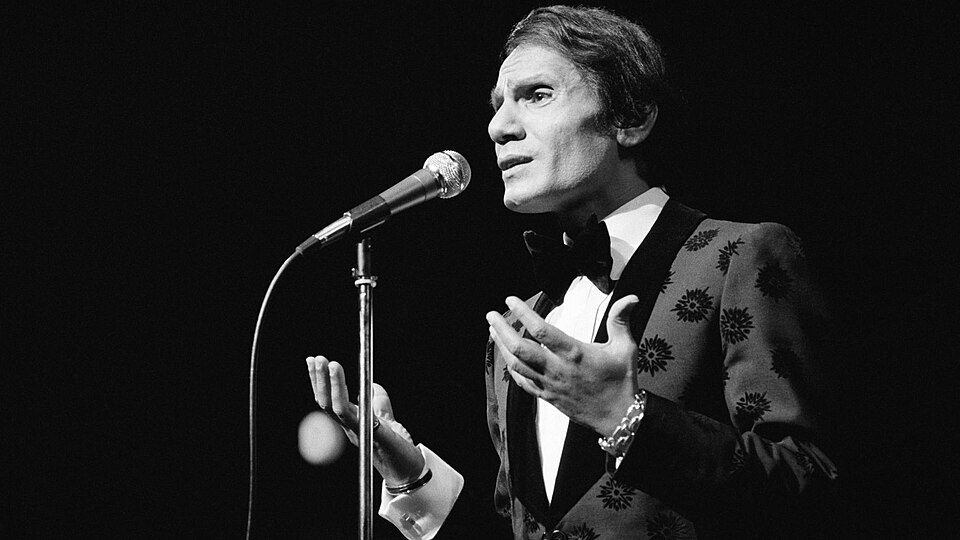
Photo: Sami.elsaadany / CC BY-SA 4.0 via Wikimedia Commons
In 1957 a young singer from the Nile Delta stood in front of a film camera in Cairo and sang a song called "Khosara". The word means a loss, or what a pity. The film was Fata Ahlami (The Man of My Dreams), the singer was Abdel Halim Hafez, already on his way to becoming the most loved romantic voice in the Arab world, and the music was written by Baligh Hamdi, a composer in his twenties who would go on to write for Umm Kulthum. The song is a love song and, as its title says, a lament, and Hamdi's arrangement turns on a short phrase for flute and strings.
Forty-two years later that phrase became the bed of a rap song about money and women. Timbaland looped it, Jay-Z and the Texas duo UGK rapped over it, and "Big Pimpin'" reached No. 18 on the Billboard Hot 100 in 2000, the highest chart placing UGK ever had. On 26 October the NFL, Apple Music and Roc Nation announced that JAY-Z will headline the Super Bowl LXI halftime show at SoFi Stadium in Inglewood, California, on 14 February 2027. Nobody has published a setlist. But if the flute comes in that night, the most-watched stage in American television will be playing a Cairo lament.
That flute line is the clearest case there is of a rule American pop still runs on. When it borrows from the world's archives, it pays whoever holds the contract. The person who wrote the music, or their family, gets no forum in the United States to say what the music should not be made to mean. The fight over "Big Pimpin'" ran from 2007 to 2018, and it settled the first question so thoroughly that nobody now asks the second.
From Sout el Phan to a CD of "free" music
The paper trail starts in Egypt. According to the facts laid out by the US Court of Appeals for the Ninth Circuit in its 2018 ruling, Hamdi licensed rights in "Khosara" to the Egyptian label Sout el Phan in 1968. He died in 1993 and his heirs inherited what he had kept. In December 1995 Sout el Phan passed its publishing rights outside Egypt to EMI Music Arabia.
In 1999 Timbaland and Jay-Z built "Big Pimpin'" on the loop, for the album Vol. 3... Life and Times of S. Carter, released days before the new millennium. They believed the music was in the public domain and asked nobody. EMI disagreed, and in late 2000 Timbaland paid it $100,000 to use "Khosara" in the song. At the 2015 trial Timbaland described pulling the loop from a CD of Middle Eastern music he assumed was in the public domain, and argued that the drums, not the flute, were what made the record. Jay-Z testified that he believed the sample had been properly licensed.
Hamdi's nephew, Osama Ahmed Fahmy, heard "Big Pimpin'" in December 2000. Two years later, acting for the heirs, he signed a new agreement with Mohsen Mohammed Jaber, owner of the Egyptian company Alam el Phan, which had taken over Sout el Phan's catalogue. For 115,000 Egyptian pounds he assigned Jaber the right to use Hamdi's music by any means in the world, including, in the contract's own words, "musical re-segmentation and alteration methods". The heirs kept their royalties for public performance and mechanical reproduction. Everything else went.
The trial where the jury never heard the song
Fahmy sued Jay-Z, Timbaland, the labels and others in Los Angeles in 2007. His case rested on something Egyptian law has and American law mostly does not: a moral right. Article 143 of Egypt's 2002 copyright law gives an author a "perpetual, imprescriptible and inalienable" right to stop a "distortion or mutilation" of the work, whoever owns the money side. Fahmy's lawyers argued that setting Hamdi's music under lyrics they called vulgar was exactly that kind of distortion, and that the right to make adaptations could never have been sold.
The trial opened on 13 October 2015. Before it began, the judge, Christina Snyder, barred Fahmy's side from playing recordings of "Khosara" to the jury, because the 1992 recording they wanted to use was not part of his copyright. So in a case about whether one song had been turned into another, the jurors never heard the first song. They never reached a verdict either. On 21 October Snyder ruled that the 2002 agreement had transferred the right to make derivative works, so Fahmy had no standing to sue.
On 31 May 2018 a three-judge panel of the Ninth Circuit agreed. American copyright law, it noted, recognises moral rights only for certain works of visual art, and the Berne Convention only promises foreign authors the same protection Americans get. The panel then quoted Egypt's own remedy, Article 144. Only the author can invoke it, only in an Egyptian court, only to stop circulation of the work, and only after paying "fair compensation" in advance to whoever holds the economic rights. Even at home, the judges wrote, Fahmy could have won nothing but an injunction, and he would have had to pay Jay-Z for it first.
There is an odd footnote to all this. The one point on which Fahmy's lawyers and Jay-Z came closest to agreeing was the lyrics. When his book Decoded came out in 2010, Jay-Z told an interviewer that reading his "Big Pimpin'" verse on the page was harsh, and that he could hardly believe he had written it. The heir objected to what the words did to the music, the rapper had his own doubts about the words, and the law had no use for either view. It only asked who signed what.
The same question, asked of holograms and machines
That ruling looks narrow, a case about one Egyptian contract. Its logic now covers much more of how the past gets used.
Take Hafez himself. In May 2021 a hologram of him sang with a live orchestra at Dubai Opera, produced by the Dubai company that had earlier staged an Umm Kulthum hologram show. In June 2025 his family objected publicly to a hologram concert at Morocco's Mawazine festival in Rabat, saying it had not been told about the show and calling it humiliating, and a company that says it holds his image rights threatened to sue the organisers for $1 million. The objection was not really about money. It was about whether a dead singer's likeness was being made into a caricature, which is a moral right argument in all but name.
Take Timbaland. In June 2025 the producer who looped a CD he thought belonged to nobody launched Stage Zero, an AI entertainment company, and introduced TaTa, a virtual pop artist built with tools from the AI music company Suno. And take the cases ADMC has covered this month: Reservoir suing Suno over 1,050 songs and Elvis Presley's rightsholders suing Anthropic over 274 songs. Every one of those suits is brought by an owner, about copying and payment. None of them can ask the question Fahmy asked, about what a work is being made to say, because in American courts that question has no standing.
This is where the line from Cairo to Inglewood ends up. Sampling grew up and learned to pay. Rap now licenses, credits and even commissions new soul records to sample, and this week The Weeknd debuted a song built on Faye Wong at Kai Tak Stadium in Hong Kong. That is progress. But the system it built answers to catalogues. When the people who made the music disagree with the people who own it, the owners decide, and the music industry's newest tools, from holograms to AI models, are being built on the same assumption.
Fifty years on
Abdel Halim Hafez died in London on 30 March 1977, aged 47, after years of illness, and Cairo buried him in one of the largest funerals Egypt had seen. The fiftieth anniversary of his death falls six weeks after the Super Bowl. Across the Arab world, "Khosara" will be played that week as what it is, a love song about a loss.
If the loop plays at SoFi Stadium in February, it will be legal, licensed and paid for, and more than 100 million viewers will hear it as the sound of a party. Both things will be true. The court settled which one counts in America. It could not settle which one is the song.
Share this story