FeatureSamantha Lee7 min read
The Weeknd's Hong Kong borrows a borrowed song, and that is pure Cantopop
Faye Wong's Seasonal Wind put Cantonese words on a Taiwanese tune. Cantopop always made other people's songs its own, and his tribute joins that line.
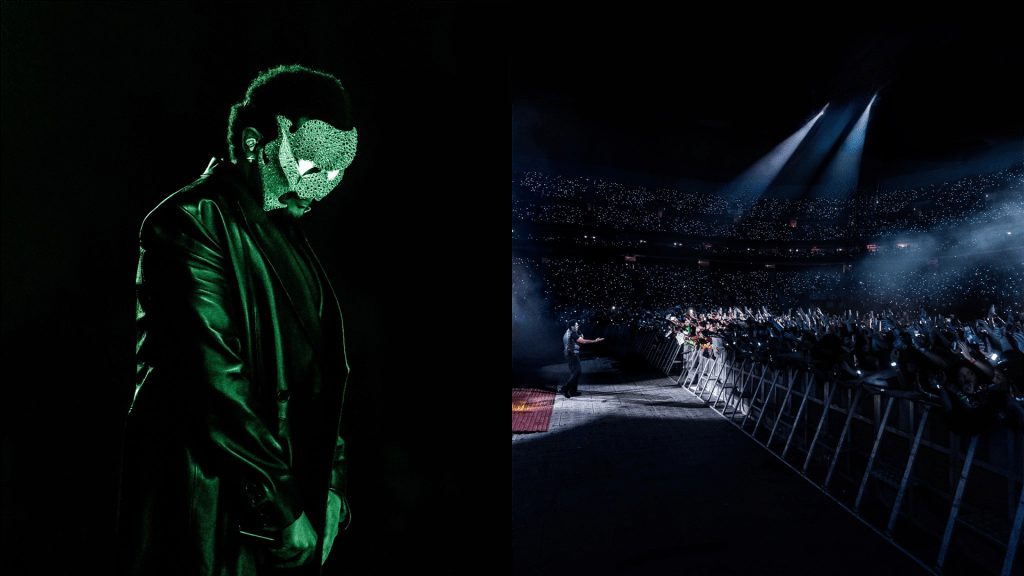
Photo: The Standard (Hong Kong)
The stadium at Kai Tak stands where Hong Kong's old airport used to be. For 73 years planes came in low over the rooftops of Kowloon and landed on a runway pushed out into Kowloon Bay, until the airport closed in 1998. On 24 October 2026, on that same ground, The Weeknd opened the first of four nights at the 50,000-capacity stadium and played a song nobody had heard before. The screens filled with red-sailed junks, red taxis, Mong Kok neon and the harbour at night. Then a woman's voice from 1993 came in, singing in Cantonese.
The song is called "Hong Kong", and it is built on "Seasonal Wind" (季候風), a ballad from Faye Wong's 1993 album No Regrets. We covered the premiere the day after: an unreleased track, a Hong Kong-only video, no release date. The reaction in the city was instant. Fans called it a love letter, and on one level that is exactly what it is.
But look closely at the sample and something more interesting turns up. "Seasonal Wind" was itself a borrowed thing: a melody by a Taiwanese composer, Cantonese words by a Hong Kong lyricist, sung by a woman who grew up in Beijing. That is not a footnote. It is how Hong Kong pop worked in its golden decades, taking songs from Tokyo, Taipei, London and Los Angeles and making them speak Cantonese. The song plays as a tribute to a lost city. What it actually does is run the city's oldest trick one more time, and in the other direction.
A song with three passports
Start with the record. "Seasonal Wind" is the fourth track on No Regrets, released on 5 February 1993 on the Cinepoly label. Its melody was written by Chen Hsiao-hsia (陳小霞), one of Taiwan's most successful pop composers, and its Cantonese words are by Poon Yuen-leung (潘源良), a Hong Kong lyricist. The singer was still billed in Chinese as Wong Jing-man (王靖雯), the "sophisticated" stage name her first label had given her to replace a name that sounded too much like the mainland.
That detail matters. Faye Wong was born in Beijing in 1969 and moved to Hong Kong at 18, without a word of Cantonese. As a teenager she had recorded cassettes of covers of Teresa Teng, the Taiwanese singer whose songs were banned on the mainland as "decadent sounds". Her first Hong Kong albums, from 1989, were full of covers of American and Japanese songs, and they sold modestly. In Hong Kong she was an outsider learning the local language note by note.
So the voice The Weeknd chose to stand for Hong Kong belongs to a migrant, singing a Hong Konger's words over a Taiwanese tune. Every part of "Seasonal Wind" arrived from somewhere else, and the song still sounds, to anyone who grew up in the city, like home.
The cover machine
That is because Cantopop was built this way. In the 1980s and early 1990s, Hong Kong's labels bought melodies from all over, especially from Japan, and handed them to local lyricists. Leslie Cheung's 1984 breakthrough, "Monica", was a cover of a song Japanese singer Koji Kikkawa released the same year. Faye Wong's own first real hit, "Fragile Woman" (容易受傷的女人) in 1992, was a cover of "Rouge", a song Miyuki Nakajima wrote for Naomi Chiaki in 1977. It took off after a popular TVB drama, The Greed of Man, used it, and Faye Wong stayed in Hong Kong to build on it instead of going back to study in the US. A year later, on 100,000 Whys, her song "Cold War" (冷戰) was a Cantonese version of Tori Amos's "Silent All These Years".
Calling these "covers" undersells the work. Cantonese is a tonal language, so a lyric has to follow the rise and fall of the melody or the words come out meaning something else. The lyricist's job was close to translation and closer to rewriting: find words that fit a Japanese or American tune's shape and still say something about life in a crowded port city. The imported melody was the frame. The Cantonese words were the part that belonged to Hong Kong.
Read that way, "Hong Kong" is a very Cantopop move. A star from elsewhere takes a melody he did not write, puts his own language and sound on top of it, and offers it back to the city as something local.
The city that came from a film
There is a second borrowing in The Weeknd's song, and it is about the picture rather than the sound. The video that played at Kai Tak was shot by Evan Larsen, who has said The Weeknd is a big fan of Hong Kong films from the late 1980s and early 1990s. Its blue streets and smeared neon point straight at one director, Wong Kar-wai, and one film, Chungking Express.
Released in 1994, Chungking Express is the reason a lot of people outside Asia know what Faye Wong looks like. She plays a snack-bar worker who plays "California Dreamin'" by The Mamas & the Papas on a loop, and her own song "Dream Person" (夢中人) runs through the film. That song is a Cantonese version of "Dreams", a 1992 single by Limerick band The Cranberries.
So the Hong Kong the world carries around in its head, the one in the video, is a city seen through a film, scored by a Beijing-born singer singing an Irish song in Cantonese, next to an American song from 1965. The Weeknd clearly knows that film. Before his Kai Tak shows he had dinner with Tony Leung, who starred in it, and posted the photo with "Dream Person" playing underneath.
Faye Wong went global through other borrowed doors too. In 1999 she sang "Eyes on Me", the theme of the video game Final Fantasy VIII, built on the game's own main melody. It became the first video game song to win Song of the Year (Western Music) at the Japan Gold Disc Awards. Japanese listeners knew her first as the voice of a game.
Toronto, Tokyo and back
The Weeknd's interest in East Asian pop is not new, and it has always come through samples. "Out of Time", a single from his 2022 album Dawn FM, is built on the intro of "Midnight Pretenders", a 1983 song by Japanese singer Tomoko Aran, and the credits list Aran and Tetsuro Oda as writers.
There is also a quieter line between his city and this one. The Weeknd grew up in Scarborough, in Toronto. In the years before Britain handed Hong Kong back to China in 1997, hundreds of thousands of Hong Kongers emigrated to Canada, and Toronto and Vancouver took most of them. The peak was 1994, the year of Chungking Express, when more than 44,000 arrived in a single year. The city The Weeknd comes from has had a large Cantonese-speaking community ever since, long before he played Kai Tak.
That is the "other direction" in this story. For decades Hong Kong took songs from Tokyo and Taipei and the West and made them local. Now a Toronto star takes a Hong Kong song back out into the world, carrying Cantonese words in a language most of his listeners do not speak. The flow has reversed, but the method is the same one Cantopop always used.
What a good borrower owes
The nostalgia reading of "Hong Kong" is easy to make: a foreign star, a 1990s voice, a film-tinted video, a city that has changed fast since then. The old airport under the stadium is the perfect symbol. The planes are gone, and so, people say, is that Hong Kong.
We think the more useful reading is the one the sample itself teaches. Cantopop was never about the original. It was about what a song became when it landed in Hong Kong, and about the people who did the landing: the lyricist who found Cantonese words that fit a Japanese melody, the singer from Beijing who learned to sing them, the TV drama that put them in every living room.
Which brings us to the one thing still undecided. "Hong Kong" has no release date and no published credits. If it comes out, the test of the tribute is simple. Cantopop records credited the composer of a borrowed melody, and the city's lyricists were stars in their own right. A version of "Hong Kong" that credits Chen Hsiao-hsia's melody and Poon Yuen-leung's words, and not only Faye Wong's voice, would be one that understood what it borrowed. That is how Hong Kong always did it.
Share this story