FeatureNatalia Pedroza7 min read
Sepultura ended without the Cavaleras, and the band that ended had earned the name
On Saturday, 18 of the 30 Sepultura songs played came from the Max Cavalera years. That is the purists' best card, and it proves the opposite.

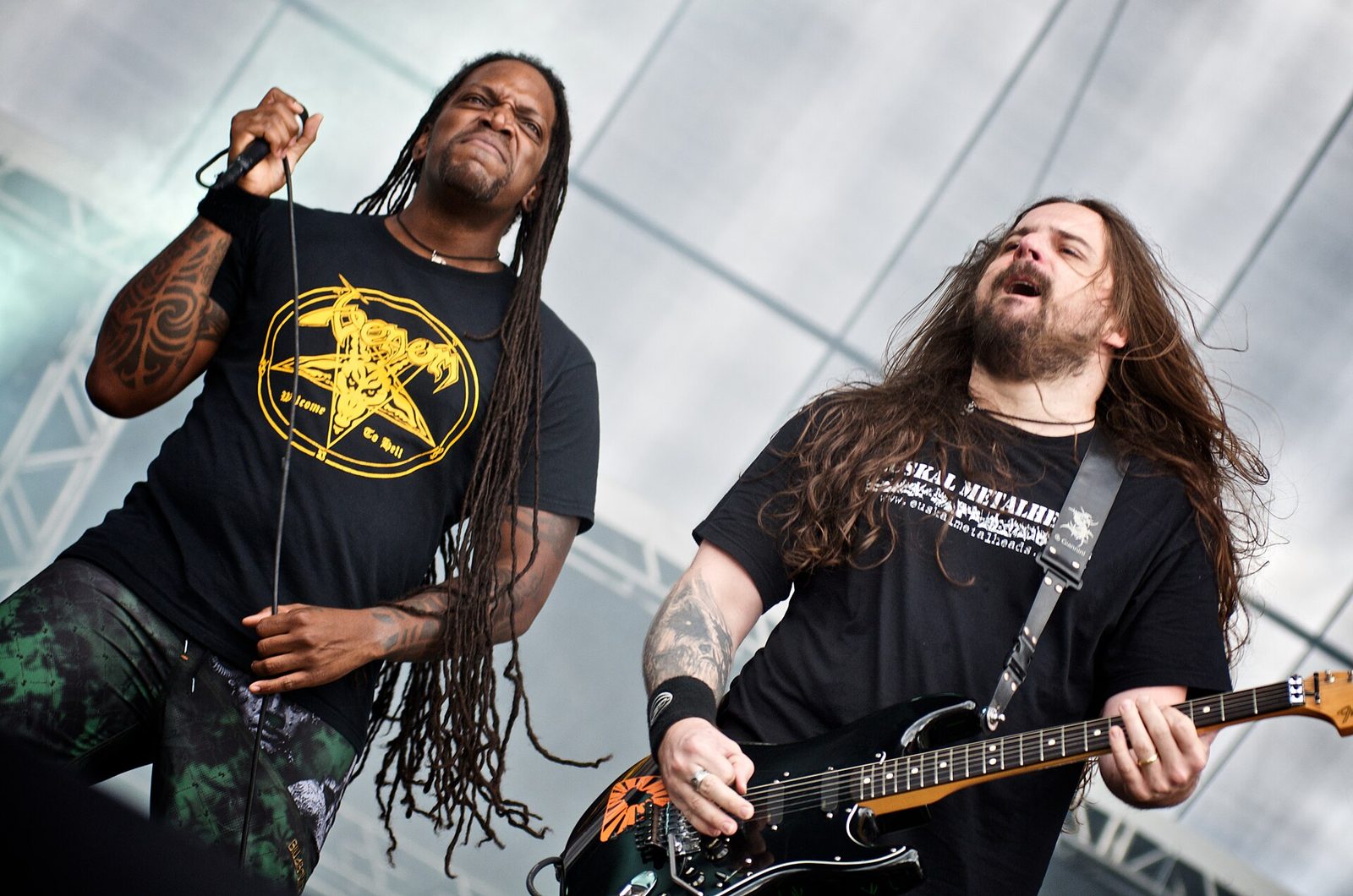
Photo: Sepultura press photo, courtesy of Nuclear Blast Records
Near the end of Sepultura's last show, on Saturday night in São Paulo, Derrick Green picked up a guitar. The song was "Troops of Doom", written in Belo Horizonte for the 1986 album Morbid Visions, when Green was a 15-year-old in Cleveland, Ohio. Next to him stood Jairo Guedz, the guitarist who left the band in 1987. Behind them, Andreas Kisser, who replaced Guedz that year, and Paulo Jr., who had been on bass since 1984.
Two people were missing: Max and Iggor Cavalera, the brothers who started the band. For a lot of metal fans, that absence settles the question of the night. They say the real Sepultura ended in December 1996, when Max played his last show with the band at London's Brixton Academy, and that everything after was a long tribute act keeping a famous name warm.
We think they have it backwards. Sepultura was right to end as Sepultura, without the Cavaleras, because the songs the purists call the real band were kept alive for nearly three decades by the line-up they call the copy. Saturday's setlist, which looks at first like the purists' best evidence, is the proof.
The case against, at full strength
Take the other side seriously first, because it has real numbers behind it.
The farewell was booked for the Mercado Livre Arena Pacaembu, a stadium that holds around 26,000 people. In September, Live Nation Brasil moved it to the Suhai Music Hall, which holds just over 9,000. No reason was given. For Brazil's most famous metal band, playing its final show in its biggest city, that is a hard fact to explain away.
Then there is the setlist. By our count of the published running order, the band played 30 of its own songs on Saturday, plus two Ratos de Porão covers. Eighteen of those 30 came from the six albums made with Max Cavalera between 1986 and 1996: "Arise", "Refuse/Resist", "Territory", "Ratamahatta", "Roots Bloody Roots" and the rest. The night opened with the title track of Arise (1991) and closed with the first song on Roots (1996). Even at their own funeral, the purists say, the band leaned on the brothers' records.
And Max Cavalera has made the argument himself. In a 2025 radio interview he said, in effect, that the band still carried the name but everyone knew it was not the same group and never would be. When Kisser was asked about that, he answered with a question of his own: after forty years, who stays the same?
Whether the brothers were even asked to play Saturday is disputed. In March, Kisser said in an interview that the band had invited them and that they had declined. Gloria Cavalera, Max's wife and manager, answered on Instagram that nobody had contacted Max or his team. We cannot settle that, and the argument here does not depend on it.
Who actually sang the classics
Here is what the 18-of-30 count hides. Max Cavalera sang "Refuse/Resist" with Sepultura for about three years: it came out on Chaos A.D. in 1993, and he was gone by the end of 1996. "Roots Bloody Roots" was released in February 1996, so he sang it on stage with the band for less than a year.
Derrick Green joined in 1997, after a two-week audition in São Paulo, and sang both songs at Sepultura shows for the next 28 years. The same goes for "Arise", "Territory", "Dead Embryonic Cells" and "Beneath the Remains". Several generations of fans, on every continent the band toured, heard those songs live for the first and only time in Green's voice, because Green was the only Sepultura singer touring them for most of their existence.
That is what a band is, once it lasts long enough. Songs are not frozen at the moment of recording. They live on stages, and for 29 years the people putting these ones on stages under the Sepultura name were Kisser, Paulo Jr. and Green, with a run of drummers after Iggor left in 2006: Jean Dolabella, then Eloy Casagrande until he joined Slipknot in February 2024, then Greyson Nekrutman. The farewell tour that ended on Saturday started on 1 March 2024 at Arena Hall in Belo Horizonte, the city where the band formed. That is not a cover band's itinerary.
Read the count the other way and it says something else. A band that had made nine studio albums and an EP since 1998 still gave more than half its last night to songs written before its singer arrived. That is not a band hiding from its past. It is a band that treated the whole catalogue as its own, because by then it was.
The years the purists skip
The bigger mistake in the purist view is treating the Green era as one long epilogue. It was longer than the original story, and it had its own life.
Against, the 1998 album that introduced Green, sold less than the records before it, as fans adjusted to a new voice. One of its songs, "Reza", was a collaboration with João Gordo of Ratos de Porão, the São Paulo hardcore band. On Saturday, Gordo was there to sing it again, its first live outing since 2005, and Ratos de Porão stayed on for two of their own songs. That is a band paying debts to its home scene, not to a brand.
Dante XXI (2006) was a concept album built on Dante's Divine Comedy, an idea Green brought to the band. In November 2008, Sepultura played the Latin Grammys in Houston, opening with a burst of "The Girl from Ipanema" before a new song called "We've Lost You". That song returned to the set on Saturday for the first time since 2015. With the Latin Grammys back on Thursday, it is worth remembering that a Brazilian thrash band once took that stage with an American singer and a bossa nova standard.
The last thing Sepultura recorded, The Cloud of Unknowing, a four-song EP released by Nuclear Blast on 24 April 2026, carries the clearest sign of whose band this had become. Its lead single, "The Place", is about migrants. Green, an American who moved to Brazil to replace a singer many fans thought could not be replaced, put it plainly when the song came out: "This song deals with immigrants who have come to a place seeking refuge and start a new life." Kisser described the sessions as having happened without deadlines or label pressure, and said of them: "It was very spontaneous."
What the brothers kept, and what the name is for
None of this takes anything from Max and Iggor Cavalera. They wrote the records that made Sepultura one of the few bands outside Europe and North America to change how metal sounded, from the Brazilian riot footage in the "Refuse/Resist" video to the Xavante recordings on Roots. Since leaving, they have kept those songs alive their own way. In 2023 they re-recorded Bestial Devastation and Morbid Visions under the name Cavalera, and Schizophrenia followed in June 2024. The label for those re-recordings was Nuclear Blast, the same label that put out Sepultura's final EP. For the last few years, one company was releasing both sides of the argument.
That is the honest settlement. The brothers own their authorship, and nobody can take it from them. But a band name is not a deed to the past. It is a promise about the present: these people, on this stage, tonight, playing these songs as well as they can. Sepultura kept that promise for nearly 30 years after Max left and 20 after Iggor did. When the band announced the farewell in December 2023, it said it had chosen to depart "via a conscious and planned death." It then spent nearly three years doing exactly that, on several continents, and ended at home.
As for the smaller room, a stadium would have been a bet on the legend. Nine thousand people in São Paulo on a Saturday night is a measure of who was still listening, and the band played that room for two hours and forty minutes, digging out "Itsári" for the first time since 1998 and "Altered State" for the first time since 2013. Sepultura did not end as a tribute to the band it used to be. It ended as the band that had outlasted it.
Share this story