FeatureEva Waxenberg7 min read
Michael Kiwanuka helped build 2020s British soul. Fudge is him walking out of it
Sold in 2012 as London's Bill Withers, he broke out with Danger Mouse and Inflo, and SAULT and Little Simz followed. Fudge is made without them.
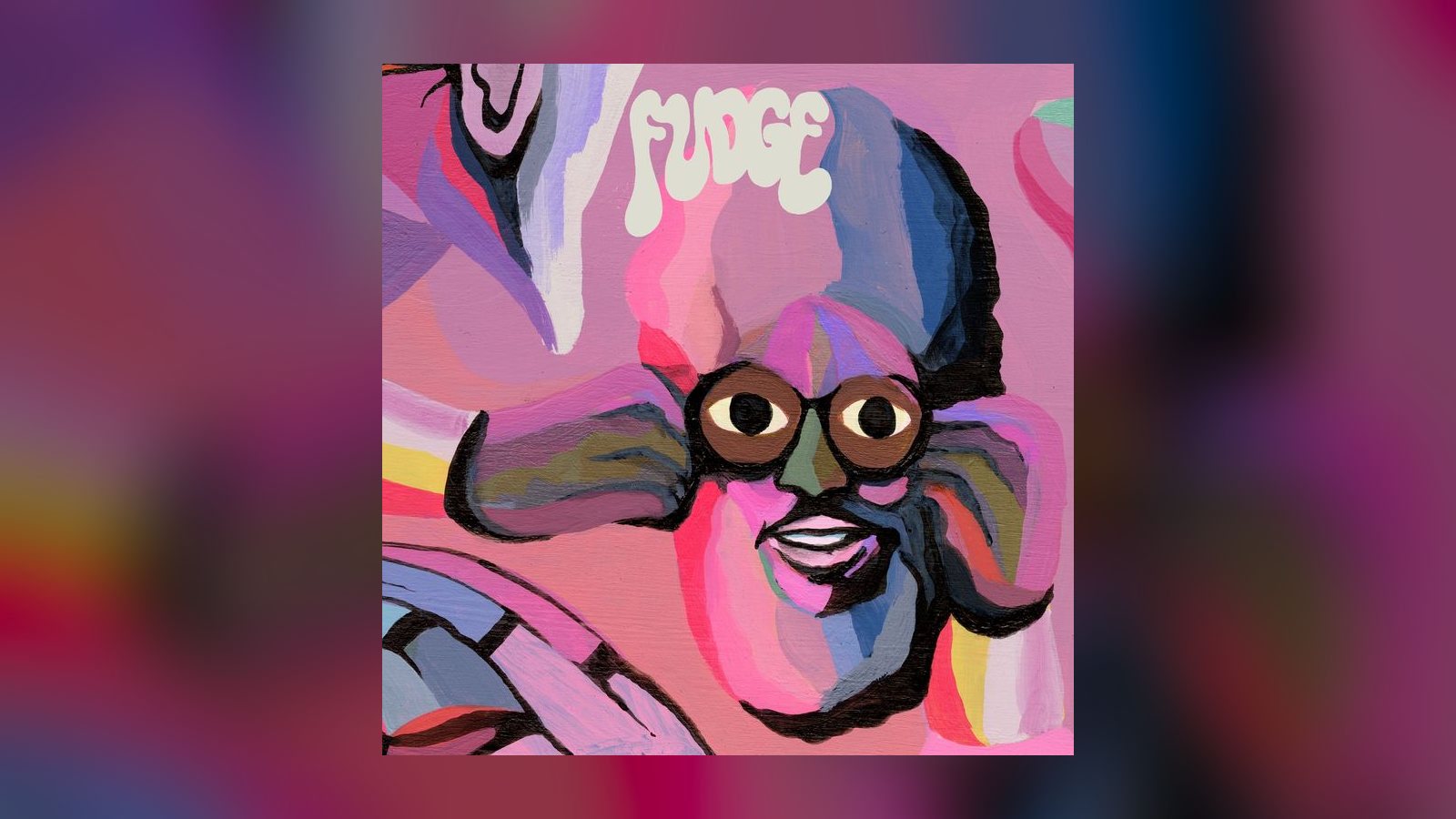
Artwork: Stevie Gee / Polydor Records
In early 2015, Michael Kiwanuka was stuck. His debut had gone top five in Britain three years earlier, the follow-up would not come, and a trip to Kanye West's Yeezus sessions in 2013 had left him, by his own later account, feeling out of his depth and sneaking out of the room. Then Danger Mouse rang and asked him to come to his studio in Los Angeles.
What came out of that call was not just a second album. It was a way of making soul records, widescreen, choral, string-laden, angry and tender in the same breath, that a London producer named Inflo would carry far beyond Kiwanuka's own catalogue. By the end of the decade it had a Mercury Prize, a mysterious collective called SAULT and a Little Simz masterpiece to its name.
Today Kiwanuka releases FUDGE, his fifth album, and he made it without Danger Mouse or Inflo for the first time since that phone call. Our reading of the through-line is simple: Kiwanuka helped build the house that one of Black British music's strongest strands has lived in this decade, and FUDGE is the sound of him stepping outside it to find out what was his alone.
Back: the Withers problem
Kiwanuka was born in Muswell Hill, north London, in 1987, to Ugandan parents who had fled Idi Amin's regime. He came up as a hired guitarist for the grime and rap acts Chipmunk and Bashy, then put out two EPs on the small Communion label in 2011, signed to Polydor, opened for Adele and won the BBC's Sound of 2012 poll.
The record that followed, Home Again, came out on 12 March 2012. It was made with Paul Butler of The Bees in a basement studio under Butler's house in Ventnor, on the Isle of Wight, and it sounded like it: warm, close, a little tape-hissy, all brushed drums and flute. It reached number four in the UK, number one in the Netherlands, and made the Mercury shortlist.
It also gave him a label he could not shake. Nearly every write-up reached for Bill Withers, with Terry Callier, Curtis Mayfield and Marvin Gaye close behind. The comparisons were meant kindly, and they were not wrong about the voice. But they filed a 24-year-old Londoner as a tribute to 1972. His own list of heroes always included Jimi Hendrix and Nirvana too: guitar noise, not just the coffeehouse.
The escape: Love & Hate
Love & Hate, released on 15 July 2016, is where the second Kiwanuka arrives. Danger Mouse produced most of it, Inflo produced or co-produced seven of its ten songs and arranged the strings on three, and Butler produced the remaining three.
The opener, "Cold Little Heart", runs 9 minutes and 57 seconds, and it takes its time getting to the voice: a slow swell of choir, strings and a weeping lead guitar that, to our ears, owes more to Funkadelic's Maggot Brain than to Withers' Just As I Am. HBO picked it as the opening theme for Big Little Lies in 2017, which put it in front of an American audience that had never heard of the Sound of 2012 poll.
The lead single, "Black Man in a White World", released on 28 March 2016 with a video by Hiro Murai, was the other half of the formula: a gospel chant over handclaps and a bassline, a plain statement of racial dislocation sung as if from a church pew. Inflo co-wrote it, and the song won the Ivor Novello Award for Best Song Musically and Lyrically.
The album went to number one in the UK. More important for this story, it established a grammar: long-form suites, choirs as a lead instrument, strings that sound recorded in a large cold room, protest lyrics delivered without shouting, and a refusal to choose between retro warmth and modern scale.
KIWANUKA, in November 2019, pushed it further, with songs bleeding into each other through interludes, one of them, "Hero", written about the murdered Black Panther leader Fred Hampton. Danger Mouse and Inflo co-produced it. It won the Mercury Prize in September 2020, and earned Inflo a Grammy nomination for Best Rock Album as producer.
Forward: the house Inflo built
Inflo, born Dean Josiah Cover, is the reason the through-line does not stop at Kiwanuka's discography. In 2019, the same year as KIWANUKA, he produced Little Simz's Grey Area and launched SAULT, a collective that released records with no faces, no interviews and no videos. Its first two albums, 5 and 7, came out in May and September 2019.
Listen across those records and the Love & Hate grammar is everywhere. SAULT's Untitled (Black Is), which arrived in June 2020 during the protests that followed the murder of George Floyd, is a suite of chants, basslines and spoken passages about Black life in Britain and America, protest delivered at a murmur. Its lead vocalist, Cleo Sol, Inflo's wife and closest collaborator, made her own solo records, Rose in the Dark in 2020 and Mother in 2021, in the same hushed, devotional key.
Then came Sometimes I Might Be Introvert in 2021, Little Simz's orchestral, choir-backed album. It won the Mercury Prize in October 2022, two years after KIWANUKA, and in her acceptance speech Simz thanked Inflo for sticking by her through the making of it. Earlier that year Inflo had become the first Black producer to win the Brit Award for Producer of the Year. He also worked on three songs on Adele's 30.
Put the timeline in a row and it reads like a family tree. Love & Hate's strings in 2016, Kiwanuka's suite-like KIWANUKA in 2019, SAULT's debut the same year, two Mercury Prizes in three years, and now Cleo Sol taking that hushed sound into Madison Square Garden and six more North American arenas in April and May 2027. SAULT, who did not play a single show until December 2023, headlined London's All Points East in August 2025.
None of this means Kiwanuka invented that sound alone, and it would be unfair to Inflo to say so. The fairer reading is that Kiwanuka's sessions were where the method was first proven at scale, on a major label, on a record that went to number one. After that, Inflo had the template and the credibility to run with it, and he did.
Fudge: leaving the house
Which brings us to today. FUDGE is a 12-song album on Polydor, written in 2023 alongside the songs for 2024's Small Changes, his last record with Danger Mouse and Inflo. Kiwanuka led production himself, starting sessions at a studio space near his home in Southampton with Joe Connell, the multi-instrumentalist from his live band, who stayed through the whole record. Dom Marks was brought in to help finish it in the last weeks. The opener and first single, "Summer Clothes", carries words from the late jazz pianist Chick Corea.
The album was finished before Kiwanuka fell ill. He cancelled festival dates in July 2025, citing illness, and in September this year he explained why. "A few months ago I suffered a stroke brought on by a bleed in my brain brought on by high blood pressure," he wrote on Instagram, adding that the recovery was long and that he did not know when he could return to the road. "I'm fighting to get better." His live dates are on hold while he goes through rehabilitation.
That context will colour how FUDGE is heard, and it should not be the whole story. The decision that matters for the through-line was made in 2023, by a healthy artist, when he chose to take a record away from the two producers who had defined his sound for eight years. Kiwanuka has said in the run-up that this record had to be made differently from the last few, or there was no point in making it. Even the artwork, a candy-pink painted cartoon of his face by Stevie Gee, looks like someone deciding to play.
We will leave the verdict on the songs to the listening. The through-line is already clear. The 2012 Kiwanuka was told he sounded like someone else. The 2016 to 2024 Kiwanuka made records so distinctive that a whole scene learned from them. The 2026 Kiwanuka is the first version to test whether the sound people now call British soul was his, his producers', or something the three of them only found together. It is an unusual position for an artist: to have been influential enough that the influence no longer needs you, and brave enough to go home and start again with one bandmate in a room near the south coast.
Share this story