
FeatureKatelynn Dan7 min read
H.O.T. sang about school violence in 1996. Now K-pop screens every trainee for it
Thirty years after the first idol group debuted, its protest single's subject is the allegation that ends careers, and the industry runs a school of its own.
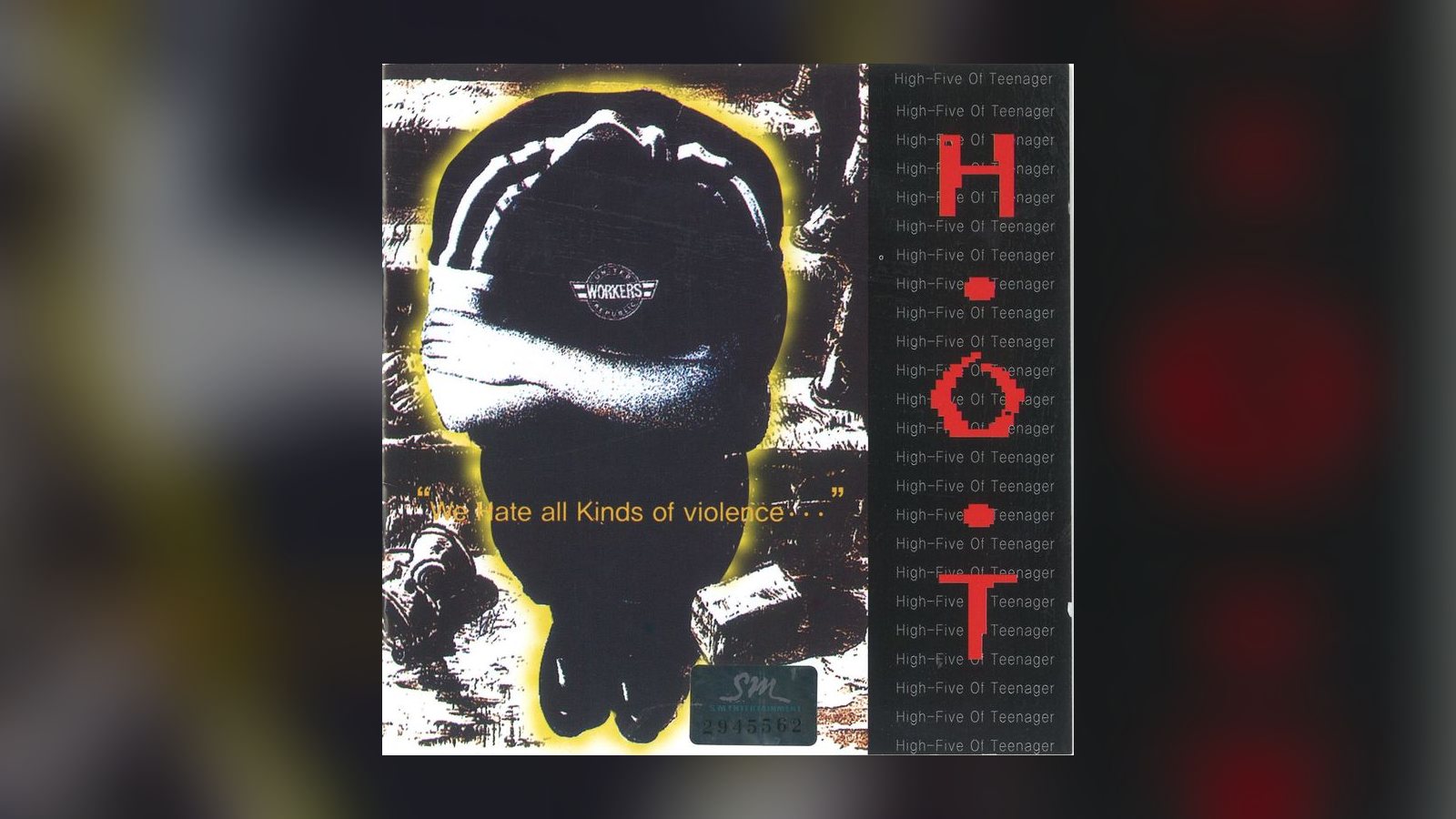
Artwork: SM Entertainment
The cover of H.O.T.'s first album is a boy curled up on a dirty floor, arms wrapped over his head, a glowing yellow outline around him like a chalk mark at a crime scene. Across the top runs the title in quotation marks: "We hate all kinds of violence..." The record came out on 7 September 1996, and the five high school students on it were about to become the template for every K-pop idol group that followed.
The single they debuted with was "Warrior's Descendant", also known as "Age of Violence". It was a song about bullying in Korean schools, written for teenagers who were living it and sung by teenagers who were still in uniform. Its producer, Yoo Young-jin, has said that school violence, then one of the country's loudest social worries, was what shaped the album's look.
Thirty years on, that subject has come all the way round. The industry H.O.T. founded now treats school violence as the one allegation a new idol cannot survive, and it screens for it the way a university screens an application. The protest song became a background check. What it never became is the thing the song actually asked for: adults taking responsibility for what they do to children.
A protest record built from a survey
For a reader meeting this history for the first time: Korean pop in the early 1990s belonged to Seo Taiji and Boys, a trio who mixed rap, metal and dance music and sang about things television did not want to hear. Their 1994 song "Classroom Idea", from the album released on 13 August that year, went after the education system and the exam treadmill that decides a Korean teenager's future. It was kept off TV and radio even after the ethics committees had passed it. The group retired in January 1996 and left a hole shaped like a generation of angry students.
SM Entertainment's founder, Lee Soo-man, filled it on purpose. Before H.O.T. existed as a band, he surveyed high school students about what their ideal pop group would look like, then cast and trained five boys to match: Moon Hee-jun, Jang Woo-hyuk, Tony An, Kangta and Lee Jae-won. The name stood for High-five Of Teenagers. The anger of "Classroom Idea" came back, but this time it had been researched, cast and choreographed.
It also came with a counterweight. The album's second single, "Candy", was a bubblegum love song, and it topped the TV music shows for weeks. Dark protest followed by sweet romance became the standard rhythm of an idol group's career, and it still is. The album sold more than 1.5 million copies in Korea and stayed SM's best seller by any act for 24 years, until NCT passed it in 2020. In 1999 H.O.T. became the first K-pop act to headline Seoul's Olympic Stadium.
The school moved inside the industry
The lineage of the school song is easy to trace. In 2013 a new group called BTS built its first three releases around school, and "N.O" from that September took aim at the promise that a good university buys a good life. In July 2017 BTS remade Seo Taiji and Boys' "Come Back Home" for that group's 25th anniversary, as part of Seo Taiji's own anniversary project, with new verses from RM and j-hope.
What is less often said is that the industry turned the school's methods into its business model. Trainees audition to get in, train for years alongside their real schooling, sit regular internal assessments, and debut only if they pass. TV survival shows made the final exam public. Then they showed that the exam could be rigged: in 2021 Korea's Supreme Court upheld a two year prison sentence for Ahn Joon-young, the producer of Mnet's Produce 101 series, for manipulating viewer votes. Mnet's parent company, CJ ENM, rehired him in 2023 and then apologised for doing so.
The numbers show how hard the exam is. A study published on 30 July 2026 by Professor Kim Jeong-seop of Sungshin Women's University counted every boy and girl group to debut from H.O.T. to the end of 2025: 1,182 of them, about 39 a year. On average they lasted 4.12 years, well short of the standard seven year first contract. Only 19 groups, 1.61 percent, ever sold a million copies of one album. Korean students know that ratio well. It is what an elite university looks like from the bottom of the class.
When the song's subject became a background check
In February 2021, Korea had a reckoning over school violence that started in sport. Anonymous posts from former schoolmates accused the volleyball twins Lee Jae-yeong and Lee Da-yeong of abuse when they were teenagers; on 15 February their club suspended them indefinitely and the national federation dropped them from the national team. Within weeks, similar posts were landing on actors and idols, and agencies spent the year issuing denials, apologies and hiatus notices.
The case that set the rule came the next year. LE SSERAFIM debuted under HYBE's label Source Music in May 2022, and allegations about one member's school years were already circulating. The agency first pushed back on the claims about Kim Garam, then put her on hiatus, and on 20 July 2022 Source Music and HYBE announced they had ended her contract and the group would continue as five. Since then, people who train idols have described agencies asking for trainees' school records and calling their old teachers before they debut. Nobody wants to spend years and millions on a group and lose it to a post about middle school.
Korean public policy caught up after the music business did. In February 2023 the former prosecutor Chung Sun-sin was appointed to lead the National Office of Investigation and withdrew a day later, after it emerged that his son had been disciplined for bullying at high school. By April the government had announced that school violence records would be kept for four years after graduation instead of two, and that every university would have to weigh them in admissions from the 2026 cycle. In the 2025 cycle, six of Korea's ten flagship national universities rejected 45 applicants over those records. The idol audition and the university entrance exam now ask the same question.
What the song actually asked for
Listen to "Warrior's Descendant" again and the target is not only the kid doing the hitting. The song is angry at a world that lets it happen, and the cover's title is a rejection of violence of every kind, including the kind adults build into systems. In that sense, the background check answers half the song. It protects the people a bully might hurt, and their stories deserve to be heard. It also puts the industry's whole risk on a teenager's past, while the industry's own treatment of teenagers gets far less scrutiny.
That treatment is still governed by weak rules. Under the law covering young entertainers, under-15s can work 35 hours a week and 15 to 18 year olds 40, a cap that consent can stretch, and it is largely up to the agency whether training time counts as work at all. Protections for minors' sleep, rest and study remain mostly recommendations. Proposals to tighten them in 2023 met a joint statement of opposition from five music industry associations.
H.O.T.'s leader, Moon Hee-jun, said on a Korean variety show this month that he has spent 11 months talking to the other four about a full reunion concert for the anniversary. Nothing is confirmed. If it happens, it will be the right moment to listen properly to the first song they ever performed. Five schoolboys sang it to adults in 1996, asking them to stop the harm done to kids. The industry that grew from that performance learned to check the kids. It has not yet finished checking itself.
Share this story