FeatureEva Waxenberg7 min read
GTA used to file Latin and African music as period colour. GTA VI plays it as pop
From Vice City's 1950s mambo to Femi Kuti's 2008 funk crate, Rockstar's radio kept the world at the edges. Burna Boy and Bad Bunny now host the present.
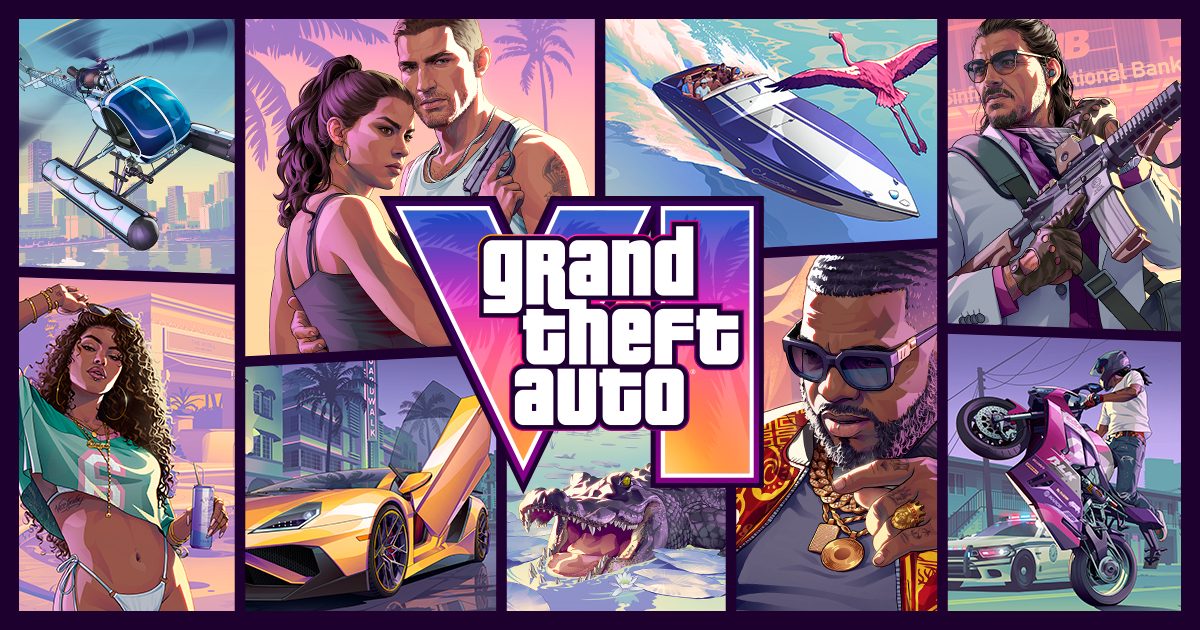
Artwork: Rockstar Games
Drive a stolen car through Vice City in 2002 and tune to Radio Espantoso, and a man called Pepe introduces Machito and his Afro-Cuban Orchestra playing "Mambo Mucho Mambo", a record from 1952. Stay on the station and you get Tito Puente's "Mambo Gozón" and Benny Moré's "Maracaibo Oriental", both from 1958. The game was set in 1986, in a city modelled on Miami. Its Latin station sounded like somebody's grandfather's record collection.
That was not a mistake. Grand Theft Auto's radio has always been one of the most carefully built things in games, and for most of its life it has done one thing with music from outside the American mainstream: filed it. Latin music became a neighbourhood. African music became a crate. Both were treated as colour around the edges of a dial whose centre was American rock, rap and pop.
On 8 October, Rockstar put the first six stations of Grand Theft Auto VI on its official music page, six weeks before the game lands on 19 November. Two of them break the old filing system. Cocoteo, "modern Latin from El Martillo and La Gata", is hosted by Bad Bunny and RaiNao, the Puerto Rican singer who sang with him on "Perfumito Nuevo". AfroBank FM, "amapiano, African classics, 3-step, and more from Burna and Palmsy", is hosted by Burna Boy and the DJ Palms Trax. Our argument is simple: for 24 years GTA's dial treated the rest of the world as the past or the neighbours, and GTA VI is the first time it treats Latin and African music as the present tense of pop. That shift is a more honest map of where pop now lives than any chart.
The crate: Femi Kuti's funk station, 2008
Grand Theft Auto IV came out on 29 April 2008, set in Liberty City, Rockstar's New York. Its radio was a portrait of an immigrant city, and a good one. Vladivostok FM, hosted by the Ukrainian pop star Ruslana, played to the Russian-speaking streets around the game's Brighton Beach stand-in. San Juan Sounds had Daddy Yankee on the mic and reggaeton for the Puerto Rican blocks. Massive B and Tuff Gong Radio covered dancehall and reggae for the Jamaican ones.
Africa got IF99, "International Funk", hosted by Femi Kuti. It was a fine station and a telling one. Of its 12 songs, four were African: Fela Kuti's "Sorrow, Tears & Blood" and "Zombie", both from 1977, Manu Dibango's "New Bell" from 1972, and Femi's own "Truth Don Die" from 1998. The rest were American funk and soul from the 1970s: War, The O'Jays, The Meters, Gil Scott-Heron. The newest record on the station was ten years old when the game came out.
So in 2008, in a game set in the present day, African music arrived as heritage. It was there because Afrobeat was a great record-collector sound that sat comfortably beside rare groove, not because anyone thought a player in Liberty City might want to hear what Lagos was dancing to that year. That was a curator's choice, and in 2008 it was also a fair reading of the market. It is still the crate.
The neighbourhood: East Los FM, 2013, and a guest spot in 2019
Grand Theft Auto V, set in Los Santos, Rockstar's Los Angeles, followed the same logic in September 2013. Its Mexican station, East Los FM, was hosted by the comedian Don Cheto and Camilo Lara of Mexican Institute of Sound, and it was excellent: Los Tigres del Norte, Maldita Vecindad's "Pachuco", La Sonora Dinamita. It was also clearly the station for the east side of town. Latin music on the GTA dial meant a place on the map, a community the player drove through.
That game is still being played. Take-Two, Rockstar's parent company, reported this year that GTA V has sold more than 230 million copies, which makes its dial one of the most heard radio line-ups in the world. When Rockstar added a new station to it in December 2019, iFruit Radio, hosted by Danny Brown with Skepta as a guest, the 27-song playlist included two Nigerian records: Burna Boy and Zlatan's "Killin Dem" and Naira Marley's "Opotoyi". Current Afrobeats had reached that enormous audience, but as a guest on a rap station run by a rapper from Detroit.
Crate in 2008, guest spot in 2019. In 2026 the same artist gets the keys to the station.
The present tense: Cocoteo and AfroBank
Look at what Rockstar chose to preview from each new station. On Cocoteo: Bad Bunny's "EoO" from DeBÍ TiRAR MáS FOToS, the album Spotify named its most streamed of 2025, the year Bad Bunny was its top global artist for a record fourth time with 19.8 billion streams. Then Romeo Santos's "Canalla", a bachata, and a dembow remix with the Dominican star El Alfa. None of it is period colour. It is the music a 19-year-old in Miami, San Juan or Madrid has on their phone this month.
AfroBank is the bigger change, because it does not even pretend to be local. Cocoteo's bachata, merengue and dembow come from the Dominican and Puerto Rican communities that actually live in South Florida, a region where 54.5 percent of Miami-Dade County's residents were born abroad, by the US Census Bureau's estimate. Amapiano and 3-step come from South Africa. AfroBank's preview runs from Asake's "Joha", a 2022 fuji-meets-Afrobeats dance record from Lagos, to a Pat Thomas highlife cut with Ebo Taylor from 1980s Ghana, to "Shay'sana" by DJ Lag, the Durban producer, with Robot Boii, from his 2024 album The Rebellion.
That spread is the point. The classics are still there, as they were on IF99, but now they sit under a present that is louder than them. And the station is on the dial of a fictional Florida not because Leonida has a large West African population, but because the people holding the controller everywhere from London to Nairobi do. Spotify has said Afrobeats streams on its service grew 550 percent between 2017 and 2022, to more than 13 billion plays that year. Burna Boy has spoken about playing the series for years before he was asked to host on it. The dial used to describe the city outside the car window. GTA VI's dial describes the world holding the game.
The rest of the music confirms the turn. Of the nine singles Rockstar has shown from the 34 original songs on Grand Theft Auto VI: The Album, released by Atlantic on launch day, three come from Latin America or its diaspora: Fuerza Regida's "Suzuki", Rauw Alejandro's "Macacoa 2000", and "Sexy Magic" with the Argentine duo CA7RIEL & Paco Amoroso. The score went to the French duo Justice. Flash FM, the Vice City pop station from 2002, comes back hosted by the Swedish singer Robyn.
The catch: the dial is rented
There is a reason to hold the celebration for a moment, and it comes from IF99 itself. On 26 April 2018, Rockstar pushed an update to GTA IV that removed songs whose licences had run out. Gil Scott-Heron's "Home Is Where the Hatred Is" disappeared from Femi Kuti's station. Later releases of Vice City lost songs the same way. Players who come to those games now hear a dial with holes in it, a city whose radio was quietly edited a decade after it was built.
Game radio is leased, not owned. Rockstar owns its 34 commissioned songs. It rents almost everything on Cocoteo and AfroBank, for a term, from labels and publishers who will be asked to renew. GTA V has been on sale for 13 years; there is every reason to think GTA VI will last at least as long, and that its dial will play in hundreds of millions of homes for most of that time.
So the real verdict on AfroBank will not come on 19 November. It will come in the late 2030s, when the licences on "Joha" and "Shay'sana" come up and someone at Rockstar decides whether Lagos and Pretoria are still the present, or whether, like Machito in 1986, they have become somebody's period colour.
Share this story