ListJane Shostak8 min read
Twelve Fela songs that map Lagos: the music on the mainland, the power in Ikoyi
Felabration ends Sunday at the Shrine in Ikeja. Fela's records name the city's streets, cells and barracks, and together they draw one line across the lagoon.
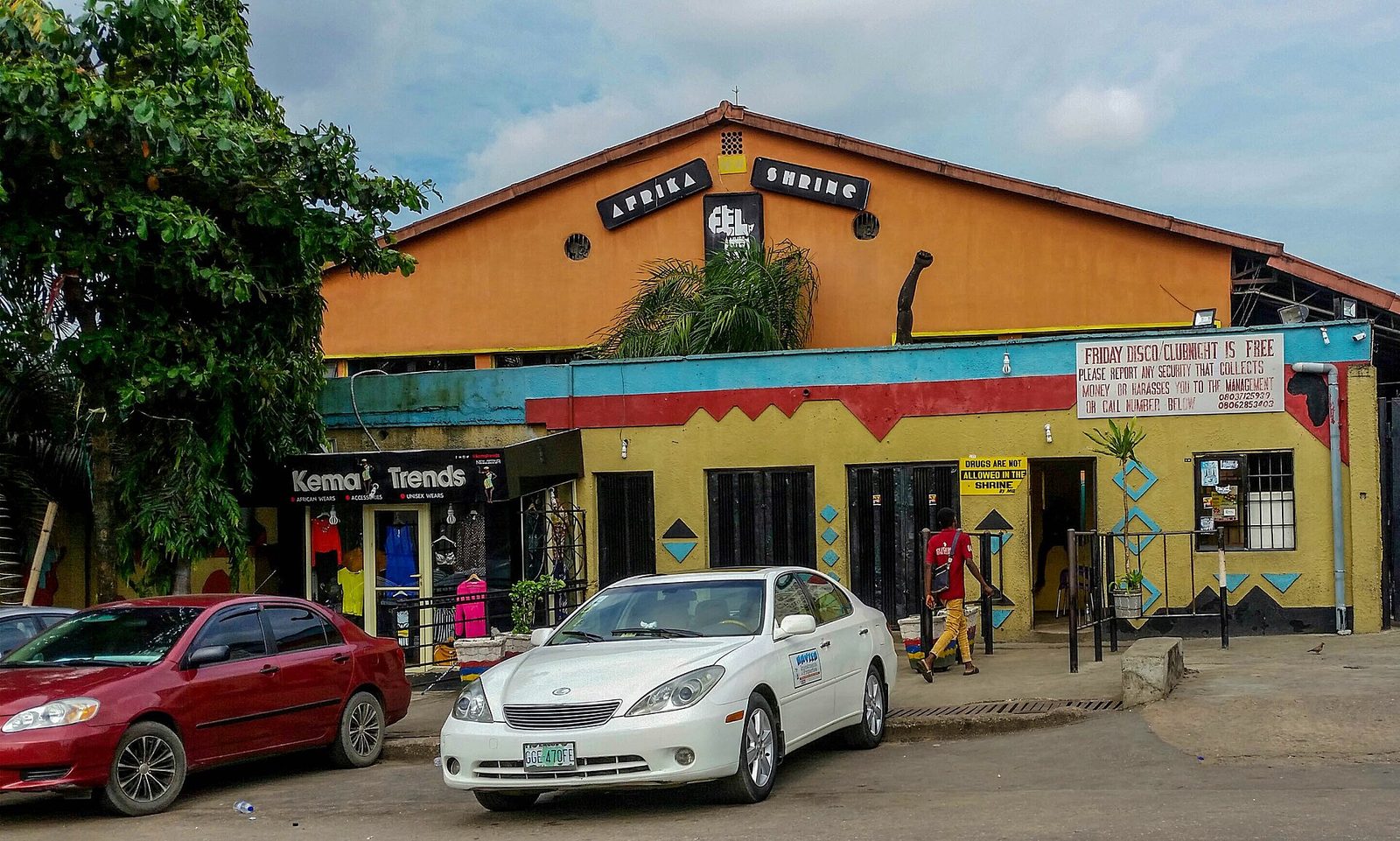
Photo: Comradeayobami / CC BY-SA 4.0 via Wikimedia Commons
All week, people have been walking into a hangar of a building in Ikeja, on the Lagos mainland, under a sign that reads AFRIKA SHRINE. Felabration, the festival Fela Kuti's daughter Yeni started in 1998, runs there until Sunday 18 October, with his sons Femi and Seun and his grandson Made Kuti at the top of the bill. Fela would have turned 88 on Thursday.
Most people outside Nigeria know Fela as a sound: Tony Allen's drums, the horn lines, songs that run past 15 minutes. Inside Lagos he was also a street directory. He put real addresses in his titles. He named the police cell, the crossroads, the barracks, the neighbourhood where the rich lived and the one where the poor did.
Lay those songs over a map and they draw a line. The music lived on the mainland: Mushin, Surulere, Ojuelegba, Ikeja. The power that kept coming for it sat across the lagoon in Ikoyi, at Alagbon Close and Dodan Barracks. These twelve songs, in the order he made them, are that map.
The two Lagoses
1. "Ikoyi Mentality Versus Mushin Mentality" (1971)
The first song where Fela draws the line out loud. It was the B-side of "Why Black Man Dey Suffer," his first openly political record, which EMI Nigeria refused to release. Ikoyi is the island suburb the British built as a colonial enclave and the Nigerian elite inherited. Mushin is the packed mainland district across the lagoon, a whole world away. Fela sides with Mushin and mocks Ikoyi's borrowed English manners. Everything that follows on this list is a version of that argument.
2. "Go Slow" (1972)
In Nigerian English a traffic jam is a "go-slow," and Lagos in the oil boom of the early 1970s had some of the worst on earth. Fela turned one into 17 minutes and 22 seconds of music on Roforofo Fight, a cool, loose groove that refuses to hurry. It is the first time he made the city's daily misery into a shape you can hear, and the length is the joke: you are stuck in it too.
3. "Eko Ile" (1973)
Eko is the Yoruba name for Lagos, and "Eko Ile" means Lagos is home. Fela had studied in London and spent 1969 in Los Angeles, and on this track from Afrodisiac he chooses the city over both. By 1972 he had moved his club into the courtyard of the Empire Hotel in Surulere and renamed it the Africa Shrine, a room for about a thousand people that was usually rammed. Home, for Fela, was a mainland address.
The island strikes back
4. "Alagbon Close" (1974)
Alagbon Close, in Ikoyi, is the headquarters of the Nigerian police's Criminal Investigation Department. In April 1974 police raided Fela's house for weed and found none; a week later they came back and tried to plant a joint, which he swallowed. He spent three days in a communal cell at Alagbon that the inmates jokingly called the Kalakuta Republic. The chorus answers the police directly: "Uniform na cloth, na tailor dey sew am." A uniform is just cloth.
5. "Expensive Shit" (1975)
The sequel, and maybe the funniest song anyone has written about a police station. The officers at Alagbon waited for the swallowed joint to reach Fela's slop bucket. His cellmates swapped buckets, the evidence never arrived, and he walked free. On his release he renamed his own home, a compound on Agege Motor Road in Idi-Oro on the edge of Mushin, the Kalakuta Republic. A prison joke from an Ikoyi cell became the name of the most famous house on the mainland.
6. "Confusion" (1975)
Twenty-five minutes, and the first half has no words at all: just Fela on electric piano and Tony Allen out of tempo, a city before anyone has organised it. When the voice arrives, it takes you to the Ojuelegba crossroads in Surulere, a short ride from the Shrine, where cars come from every direction and no policeman directs them. "For Ojuelegba, moto dey come from south / Moto dey come from north." Fela says you deserve a degree just for driving in Lagos.
7. "Everything Scatter" (1975)
A whole society on one bus. Fela sets the song among passengers riding past the Kalakuta Republic, arguing about the man inside: one repeats the government line that his people are troublemakers and hooligans, another says a troublemaker beats a sell-out. The row gets so loud the driver takes everyone to a police station. It is the map from street level: the compound is a landmark, and passing it is enough to start a fight.
8. "Kalakuta Show" (1975)
On 23 November 1974 about 70 police with tear gas, machetes and axes came through the ten-foot barbed wire fence Fela had built around the compound after the spring raids. They gassed the buildings and beat anyone they could catch, on the pretext of looking for a girl he had supposedly abducted. "Kalakuta Show" is his account of that night. Notice the direction of travel: once again the force came out from the state's offices to a mainland house.
Ikoyi, again
9. "Ikoyi Blindness" (1976)
Five years after his first Ikoyi song, Fela goes back to the island with a sharper knife. Ghariokwu Lemi's cover shows an Ikoyi man in a blindfold, blind to what happens on the other side of the water; the back cover's comic strip has a young Mushin resident standing up to a man in uniform. The flip side, "Gba Mi Leti Ki N'Dolowo (Slap Me Make I Get Money)," is about police and soldiers beating people in the street and then shaking them down.
10. "Zombie" (1976)
The song that brought the army to his door. Fela barks drill commands and his singers answer each one with "Zombie!" At the end of 1976 the government, preparing for the FESTAC arts festival, launched what it called Operation Ease The Traffic, with soldiers horsewhipping motorists in the street. Fela called it Operation Beat The Nation. On 18 February 1977 about a thousand soldiers surrounded Kalakuta, beat its people and burned it to the ground. His mother, Funmilayo Ransome-Kuti, was thrown from a second-floor window.
11. "Unknown Soldier" (1979)
The official inquiry into the attack found that an "unknown soldier" had burned the compound, and cleared the army as an institution. Fela took the phrase as his title and listed what the soldiers did, ending with his mother. She died on 13 April 1978. In October that year the army bulldozed the Shrine in Surulere. In 1979 Fela opened a new one further north on the mainland, in Ikeja, where the music has stayed ever since.
12. "Coffin for Head of State" (1981)
The one time Fela took the music across the water himself. On 30 September 1979, the day before General Olusegun Obasanjo handed over power, Fela and about sixty supporters carried a symbolic coffin to Obasanjo's headquarters at Dodan Barracks in Ikoyi and left it there. Soldiers beat them as they left. The song tells that march in 22 minutes and 42 seconds. It is the map's only crossing from mainland to island, and it was a funeral.
After the map
The line held after these records. On 4 September 1984 Fela was arrested at the airport on his way to a US tour, charged with currency smuggling and jailed for five years, first in Kiri-Kiri prison in Lagos and then in Maiduguri in the far north. Femi and the band, Egypt 80, kept the Shrine open in Ikeja until he came home in 1986.
Thirty years after "Confusion," Wizkid made Ojuelegba famous all over again. His 2014 song, named after the area where he grew up and later remixed with Drake and Skepta, is about hustling on the same streets for a break. Fela's crossroads was a picture of a broken state. Wizkid's is a starting line. Both are mainland stories told from the mainland.
The last journey on the map is the one that settles it. When Fela died on 2 August 1997, an estimated 150,000 people gathered at Tafawa Balewa Square, on Lagos Island, a short drive from the barracks and the CID offices he had sung about. Then the coffin went back to the Shrine. The official account of his life says the crowd was so thick that the 20 kilometres took seven hours. He was buried the next day in the grounds of his house in Ikeja. Every one of his songs about the island was sung from the mainland, and at the end the city walked him back there.
Share this story