FeatureVasu Khajuria7 min read
Garba's playlist hardly changes, because the circle decides which songs get in
Navratri starts today, days after 46,818 people danced one garba in Vadodara. Why the season replays its old songs, and how Khalasi became the rare new one.
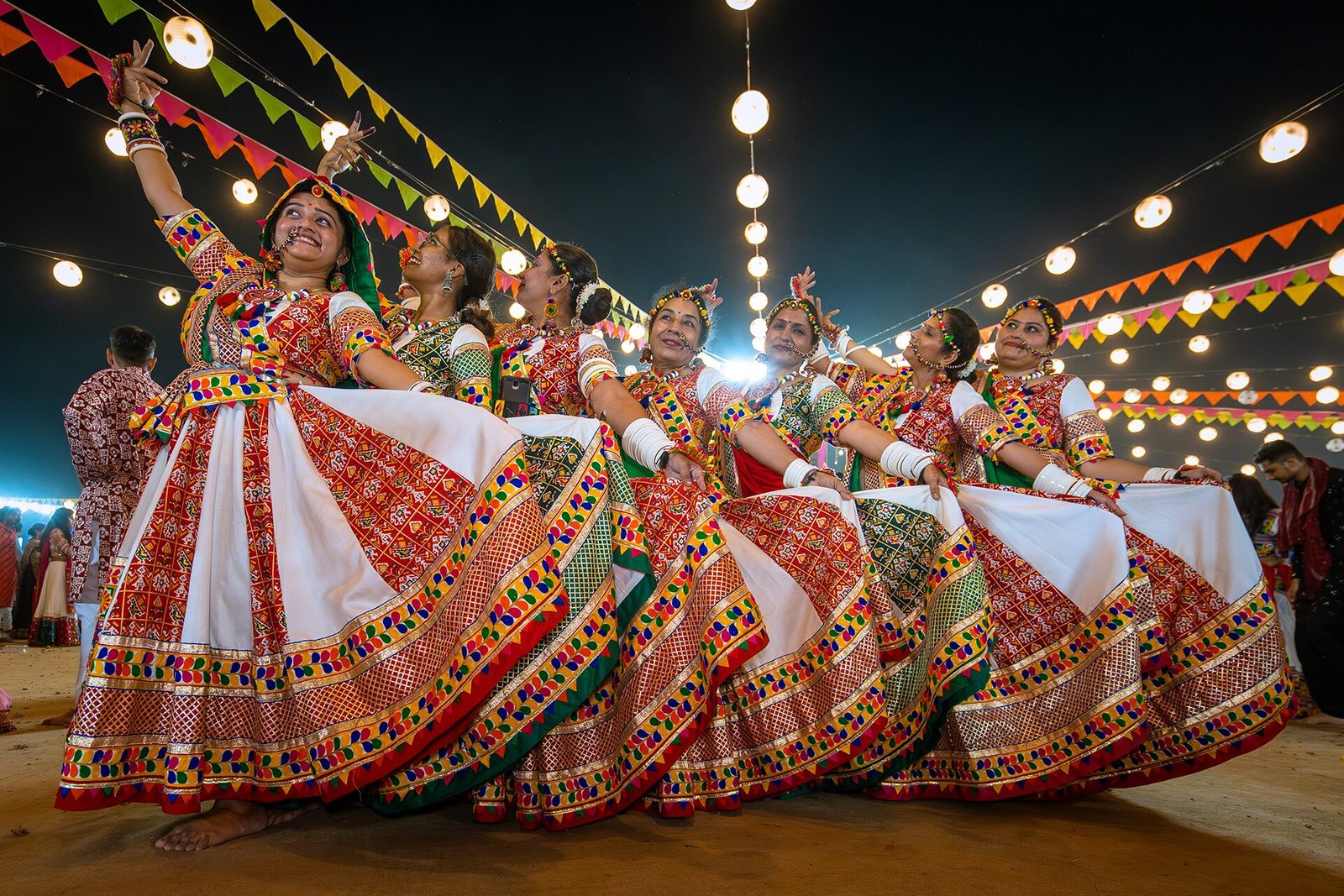
Photo: Saurabh sirohiya / CC BY-SA 4.0 via Wikimedia Commons
A little after 11pm on 7 October, on the United Way garba ground in Vadodara, Gujarat, 46,818 people moved in the same direction at the same time. They were dancing tran taali, the three-clap garba step, to the voice of Atul Purohit, the Vadodara folk singer whose garba nights the United Way ground hosts every Navratri. Guinness World Records had set a floor of 30,000 for the attempt. The city cleared it by more than 16,000, and the municipal commissioner said the certificate names the people of Vadodara as the record holders.
Tonight the real thing begins. Navratri, the nine nights dedicated to the goddess Durga, runs from 11 to 19 October this year, and across Gujarat, Mumbai, Delhi, New Jersey, Toronto, Harrow and Singapore people will dance garba for hours at a time. Take every circle together and it may be the largest dance season anywhere. Nobody has counted it properly, which is part of its charm.
Here is what anyone who has been to a garba night knows: you will hear the same songs you heard last year, and the year before, and in 1999. Our argument is that this is not nostalgia or lazy programming. Garba's playlist changes slowly because the circle, not the singer, the label or the chart, decides what gets in. And the few new songs that make it tell you exactly what a crowd of strangers needs from music when it has to move as one body.
A dance floor that faces inward
Most dance music is built for a crowd facing a stage. Garba faces the other way. When UNESCO added the Garba of Gujarat to its list of the intangible cultural heritage of humanity in December 2023, its description was plain: dancers move counter-clockwise around a lit, perforated earthenware pot or an image of the goddess Amba, singing and clapping in unison, starting slow and building to what the listing calls a frenzied whirl.
That shape changes what a song has to do. In be taali, the two-clap step, and tran taali, the three-clap one, every dancer's hands come together on the same beat. A circle of 500, let alone 46,818, only works if almost everyone already knows where the claps fall and when the singer is about to push the tempo. The drummer sets the pace and pulls it faster through a set. A song that surprises the circle is a song that breaks it.
So the core of the garba canon is not a list of favourites. It is shared muscle memory. Falguni Pathak, the Mumbai singer people call the queen of dandiya, released "Maine Payal Hai Chhankai" in 1999 on Universal Music India, and it has been in the circle ever since. The same year Ismail Darbar's "Dholi Taro Dhol Baaje", sung by Kavita Krishnamurthy, Vinod Rathod and Karsan Sagathia for the film Hum Dil De Chuke Sanam, became the Bollywood garba that DJs and live bands still reach for first. They survive because the clap is in the song.
The circle has a long memory, and it bites
The clearest proof that the circle owns these songs came in 2022. That year a remake of "Maine Payal Hai Chhankai", retitled "O Sajna" and sung by Neha Kakkar, went up on YouTube and quickly ran into the millions of views. It also drew a wave of anger. Pathak reposted fans' criticism on Instagram, said she had not been approached by the makers, and told one supporter who urged her to sue that she could not, because the rights were not hers.
That last detail is the whole story. On paper, the song belonged to someone else. In practice, it belonged to everyone who had spent 23 Navratris clapping to it, and they treated the remake as an intrusion. Remaking old hits had been a steady business for Indian labels for years. This one ran into a crowd that had memorised the original with its hands and feet, not just its ears.
We think that tells you something the remake economy misses. A song that lives on a dance floor where everyone faces each other is not a catalogue asset in the usual sense. It is closer to a folk song, and folk songs have custodians.
How a new song gets in
The canon is not frozen, though. New songs do enter, and they share a pattern.
The first is Sanjay Leela Bhansali's "Nagada Sang Dhol" from the 2013 film Goliyon Ki Raasleela Ram-Leela, sung by Shreya Ghoshal and the Gujarati singer Osman Mir. Its video went out on 2 October 2013, days before that year's Navratri. It was built on a dhol pattern a circle could lock onto in one listen, and it has never left.
The second is "Chogada" from the 2018 film Loveyatri, sung by Darshan Raval and Asees Kaur and composed by Lijo George and DJ Chetas. It is slicker than anything Pathak recorded in the nineties, but it keeps the old bargain: a steady pulse, a chorus you can shout while turning, room for the band to speed it up.
The third, and the most interesting, is "Khalasi". Coke Studio Bharat, Coca-Cola's revival of the Coke Studio format in India, released it on 5 July 2023. It was sung by Aditya Gadhvi, a singer from Surendranagar in Gujarat, composed and produced by Achint Thakkar, with Gujarati lyrics by Saumya Joshi. A khalasi is a ship's hand, and the song carries the swagger of Gujarat's seafaring coast. It went far beyond Gujarat: the campaign behind it won a silver and a bronze at the Cannes Lions in 2024, and Prime Minister Narendra Modi praised the song and its singer.
Look at the timing and the shape. "Khalasi" came out three months before Navratri 2023, long enough for choreographers and short-video creators to teach a whole country its steps over the summer. By the time the circles formed in October, people arrived already knowing where the claps went. It did not need the circle to learn it. The circle had been rehearsing.
That is the rule we take from all three. A new garba song has to arrive already known. Bollywood managed it with film promotion and a release just before the season. Coke Studio managed it with a summer of clips and dance tutorials. The internet did not replace the circle as gatekeeper. It became the rehearsal room where the circle trains before Navratri.
What the rest of music could learn from a slow playlist
Outside India, garba is usually filed under festivals or tradition. We would file it under one of the most demanding audiences in music. A club crowd forgives a DJ who drops a track it does not know. A garba circle cannot, because a song it does not know stops being a dance.
That makes the slow playlist a feature. It is why a singer like Atul Purohit can fill a ground in Vadodara year after year, why Pathak, in her sixties, is booked to sing all nine nights at the Jio World Convention Centre in Mumbai this year, and why a song from 1999 sits next to one from 2023 without anyone thinking it odd. The canon grows the way a language grows: slowly, through use, and only with words people already understand.
The Vadodara record will be remembered as a number. The more remarkable thing is what made it possible. Nearly 47,000 people did not need a rehearsal to dance tran taali together on a Wednesday night. They had been rehearsing for nine nights a year, for most of their lives. Tonight they start again, and somewhere in the first hour, someone will put on "Dholi Taro".
Share this story