FeatureVasu Khajuria7 min read
No Indian law bans Patiala Peg. Here is how a letter keeps it off Diljit's stage
A 2019 noise ruling for Punjab and Haryana now reaches Indore and Ahmedabad as child protection letters. How Diljit's song bans work, and why they stick.
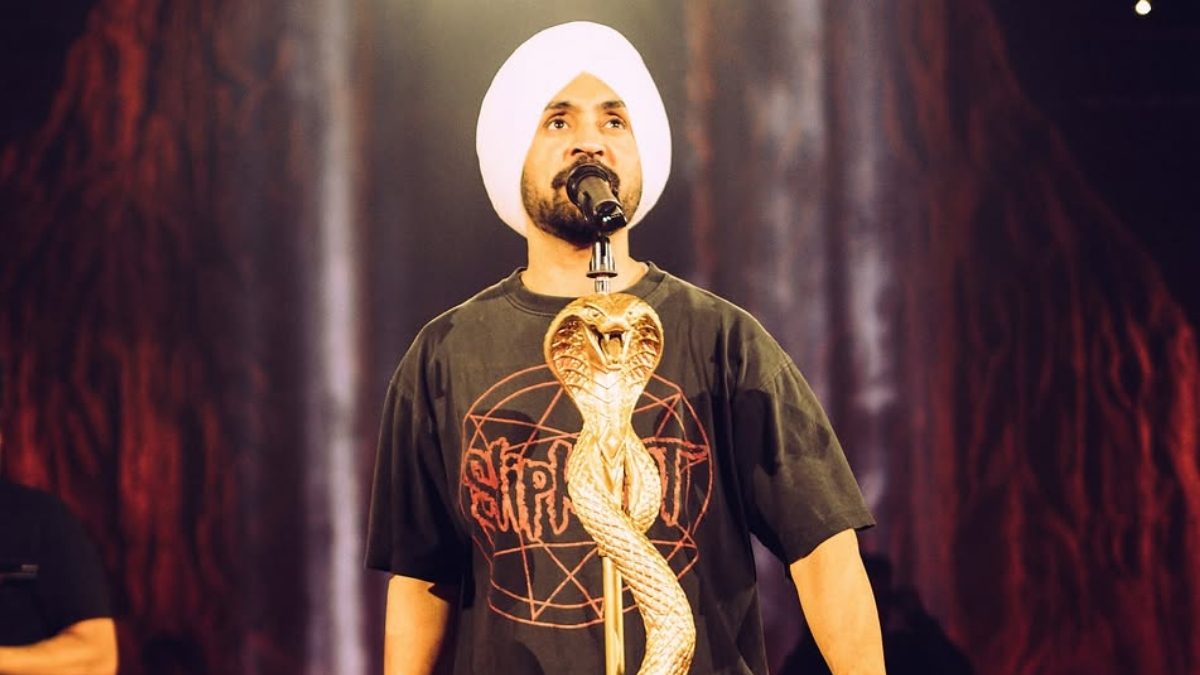
Photo: Team Diljit Dosanjh on Instagram / India TV
On 6 November, a district official in Ahmedabad wrote to the city's police commissioner about a concert 15 days away. The letter named four songs: Patiala Peg, 5 Taara, Case (the one with the line "Jeeb Vicho Feem Labbiya") and Jatt Fire Karda. It asked that Diljit Dosanjh not sing them at Narendra Modi Stadium on 21 November, not even with the words changed. It asked that children be kept off the stage, that he skip bullet belts as costume, and it flagged sound above 120 decibels and flashing beam lights as a risk to young ears and eyes.
The writer was not a judge, a censor or a minister. It was the District Child Protection Officer, whose daily work is children's homes, child labour and adoptions. The same day, the child protection office in Indore sent a near identical letter about Diljit's 15 November show there.
Here is the thing most coverage of the AURA tour has left out: no law in India bans Patiala Peg. The song has been on YouTube for about a dozen years and has more than 184 million views on the official upload. What follows Diljit from city to city is a 2019 court order about noise pollution that binds only Punjab, Haryana and Chandigarh, carried across state lines by a single complainant and posted to whoever controls the permission for the show. It works not because the songs are illegal, but because a stadium concert in India runs on permissions that nobody wants to put at risk.
The order: a noise case with one line about songs
The source of every letter is a July 2019 judgment of the Punjab and Haryana High Court in Reet Mohinder Singh v. State of Punjab, a batch of petitions about noise pollution. A bench of Justices Rajiv Sharma and Harinder Singh Sidhu issued a long list of directions. Most are about decibels and hours: no loudspeakers without written permission, no amplified sound at night outside closed premises, music up to midnight allowed only on festive occasions for no more than 15 days a year, no construction noise between 10 pm and 6 am, silencers on motorcycles, no pressure horns.
Tucked in that list is the line that matters here. The states were told to ensure that no songs glorifying liquor, wine, drugs and violence are played in live shows. The bench reasoned that glorifying violence had fed a gangster culture in the region.
Two limits are built into that order. It was addressed to the police chiefs of Punjab and Haryana and the administration of Chandigarh, and nobody else. And it sits inside a noise case. In September 2025 the same court made the second point explicit. Dismissing a contempt petition that tried to use the 2019 order to pull such songs off YouTube and Spotify, Justice Sudeepti Sharma held that the judgment was about loudspeakers in physical spaces under the Noise Pollution Rules, 2000, and could not be stretched to cover online content. Contempt, the court said, could not be used to rewrite an order. The petition also failed because it named no specific show, date or officer.
The complainant: one professor, many letters
The man behind most of the letters is Panditrao Dharenavar, a Chandigarh assistant professor who has campaigned for years against Punjabi songs about drink, drugs and guns. He has gone back to the High Court under the 2019 order more than once, and in January 2025 he got the High Court to issue a contempt notice to Punjab officials over Diljit's 31 December show at Punjab Agricultural University in Ludhiana, where, he alleged, Patiala Peg, 5 Taara and Case were sung.
That is a real legal lever, but only inside the three jurisdictions the order covers. Outside them, his method is different. He sends a representation, often with video from earlier shows, to a body that has a reason to care. Under the Juvenile Justice Act of 2015, every district in India has a District Child Protection Unit. Children attend stadium concerts. So the complaint lands with the child protection officer, who forwards it with the 2019 order attached to the people who actually control the night: the police and the venue.
The pattern is now two tours old. In November 2024, before the Dil-Luminati show in Hyderabad, a district welfare officer in Telangana sent organisers a notice built on a Dharenavar complaint, with video from Diljit's Delhi show the month before. In December 2024, Chandigarh's child rights commission named Patiala Peg, 5 Taara and Case before his Sector 34 show and said altered lyrics would not do either. This month, the Indore and Ahmedabad letters both cite the 2019 judgment. Neither city is in Punjab, Haryana or Chandigarh.
Why a letter works anyway
If the order does not bind Madhya Pradesh or Gujarat, why does anyone obey it? Because the letter does not have to be law to be expensive.
A show the size of AURA needs police permission, traffic plans, fire clearances and, in many states, an excise licence for the bar. Every one of those is discretionary, and every one can come with conditions. When the District Child Protection Unit wrote to Ahmedabad's police commissioner, police said only that they would decide in the larger public interest. That ambiguity is the point. A promoter with a stadium sold does not test whether a child protection officer can legally ban a song. They test nothing, and the setlist bends. The same leverage showed up in Pune in 2024, when Maharashtra's excise department cancelled the liquor permit for Diljit's show there.
The songs themselves are also easy to bend, which is the other reason this system survives. Diljit worked that out in 2024. In Hyderabad he sang "5 Taara hotel" in place of the liquor shop in the original. In Ahmedabad that November, in a state that has banned alcohol since it was founded in 1960, he swapped "daaru" for coke and told the crowd he would stop singing about drink the day every state went dry. In Chandigarh, Patiala Peg became Patiala Soda. The officials noticed. That is why the 2026 letters say the songs are not allowed even with changed words, a condition that appears nowhere in the 2019 order.
The double standard Diljit keeps naming
On stage in Ahmedabad on 21 November, Diljit put the sharpest version of the problem to his crowd. He pointed to Coldplay, who played the same stadium in January 2025 without any such letter, though Hymn for the Weekend has its own line about being drunk and high. He said he was Indian, that his team was Indian, and asked why the rules seemed to apply only to him, while adding that he had no problem with the restrictions themselves.
The comparison is not quite apples to apples, and it is fair to say so. No one complained about Coldplay, and these letters only move when someone files a representation. But that is exactly the weakness of the system. A rule that applies only when one person writes in is not a rule about songs. It is a rule about which artist a complainant is following. For the past two years that has mostly meant one Punjabi singer, singing in Punjabi, about a drink named after Patiala.
For a reader outside India, it helps to see what a binding version looks like. When London police wanted to stop a drill duo from performing a particular song, they went to court for an injunction that named the artists, and breaking it brought a suspended prison sentence in 2019. That is censorship with a judge's signature on it and a route to appeal. India's version has neither. It has a forwarded letter, a nervous promoter and a stage where the artist does what he can.
Diljit's answer in Indore was to recite the late Indore poet Rahat Indori's couplet that India is nobody's father's property, and to post a clip afterwards on X with the caption "ROKO… TOKO… DHAMKAO.. WE DID IT", roughly: stop us, scold us, threaten us, we did it anyway. Neither the organisers nor the police have published what, if anything, was cut.
Where the order is actually law
AURA plays Mumbai on 27 November, Bengaluru on 29 November and Lucknow on 5 December, and any of those cities could get a letter. But the tour still has one city with no date: Chandigarh. It is the only stop on the route where the 2019 order binds the police directly, and where a contempt petition is a real threat rather than a talking point.
So the strangest outcome of this whole campaign may be its last. Two years of letters have trained an artist, a promoter and a fanbase to treat a regional noise ruling as if it were national law. When Diljit finally plays the one city where it is, the crowd will already know every replacement word.
Read more: Diljit's AURA India tour, city by city and the Ahmedabad stadium night.
Up next
Argentina's rappers win abroad. At home, the country dances to Córdoba's cuarteto
While Milo J won in Las Vegas, 40,000 people danced to Q' Lokura at Vélez. A scene report on cuarteto, Córdoba's 1943 dance-hall music, and why it wins at home.
Share this story