FeatureNatalia Pedroza7 min read
Films gave the Day of the Dead its parade. They could only borrow its song
Mexico City's parade copies a Bond film and ran twice this year. Its best-known song, La Llorona, came from the Isthmus of Tehuantepec, and no studio could write it.
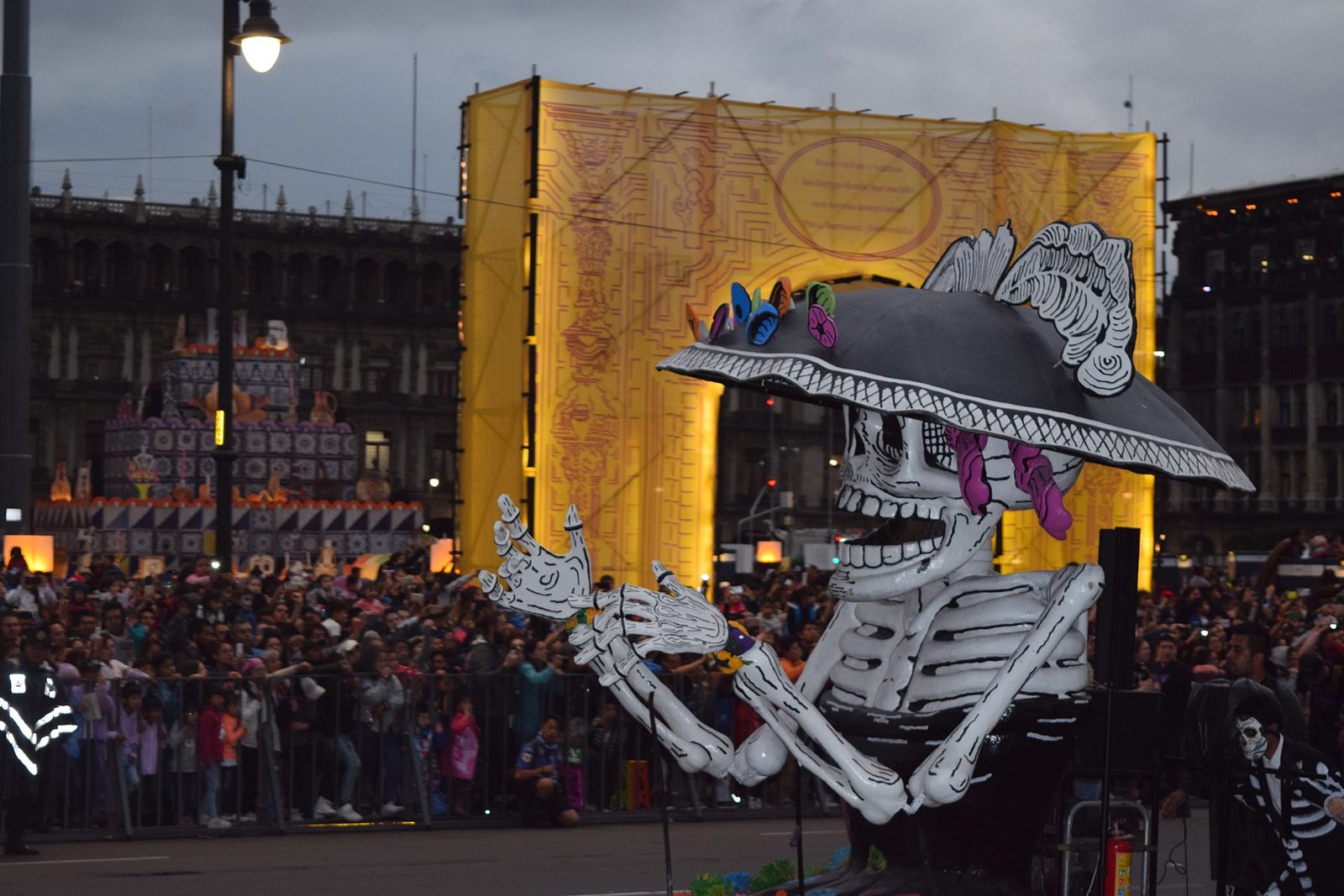
Photo: Gobierno CDMX / CC0 via Wikimedia Commons
On Saturday 31 October, at two in the afternoon, a column of giant skeletons will set off from the Diana Cazadora fountain on Paseo de la Reforma and walk to the Zócalo, Mexico City's main square. Last year an estimated 1.4 million people lined the route. Many of them will tell you the Gran Desfile de Día de Muertos is an old tradition. It is ten years old, and it started as a copy of a film.
The film was Spectre. Its 2015 opening follows James Bond through a Day of the Dead procession in the city's historic centre, all skull masks and floats. No such parade existed. Officials, worried that visitors would arrive expecting one, built it, and the first Gran Desfile ran on 29 October 2016 with more than 1,000 performers and giant skeleton marionettes in the film's image. This June the city staged it again, out of season, for World Cup visitors.
Screens have now taught the world what the Day of the Dead looks like: a Bond chase, a Pixar cartoon, a football parade. What it sounds like is a different story. Its best-known song, "La Llorona", is a lament from the Isthmus of Tehuantepec in Oaxaca, older than any of those films, and when Hollywood needed the festival to sound true, it had to borrow that song. The images could be invented. The music could not.
A parade with a score from Hollywood
Listen to Spectre's parade and you hear the problem. The cue under the opening chase, "Los Muertos Vivos Están", was composed by Thomas Newman, the film's American composer, who built it on the Bond theme. He did bring in Tambuco, the Mexico City percussion ensemble, so Mexican hands are on the drums. But the tune belongs to 007. Nobody walks to the Zócalo singing it.
That is the usual fate of film music written to sound like a place. It serves the scene and stays in the cinema. The parade the film inspired took its skeletons and its route from the screen. For its soundtrack it had to go elsewhere: brass bands, pre-Hispanic dancers' drums, the sound systems of the city's own neighbourhoods. The imitation stopped at the ears.
The song the screens could not write
Two years after Spectre, Pixar faced the same task with far more at stake. Coco (2017) is a film about music and the Day of the Dead, and it worked in Mexico like nothing before it: by November 2017 it had passed the 827 million pesos earned by The Avengers to become the highest-grossing film in the country's history, measured in pesos. "Remember Me", the original song by Kristen Anderson-Lopez and Robert Lopez, won the Oscar in March 2018, sung on the night by Gael García Bernal, Miguel and Natalia Lafourcade.
Yet the scene in Coco that stops people is not the Oscar winner. It is Mamá Imelda, a skeleton in a long dress, singing "La Llorona" on a stage in the Land of the Dead (Alanna Ubach and Antonio Sol in English, Angélica Vale and Marco Antonio Solís in the Spanish version). The studio wrote a new song to win prizes. For the moment that had to feel like the real thing, it reached for a traditional one.
"La Llorona" has no known author. It is a son istmeño, a song of the Zapotec towns around Tehuantepec, sung at weddings, festivals and wakes, in Spanish and in Zapotec. The earliest printed versions turn up in a Tehuantepec student publication from 1935 and a Mexican folklore journal from 1936. The Oaxacan writer Andrés Henestrosa said he heard it on the Isthmus around 1941, and he may have added verses as he spread it. Folklorists have since counted well over a hundred verses, and every singer picks their own. That is why there is no correct "La Llorona", and why nobody could own it, or write a new one to order.
The words are not even about the ghost story most people attach to them, the weeping woman who drowned her children. The verses are about love and death in the same breath, sung to a woman in a huipil, the embroidered blouse of the Isthmus, coming out of a church. That double meaning, a courting song you can sing at a grave, is exactly what the Day of the Dead is. A screenwriter could not have designed a better fit.
How a regional song became the nation's
Coco did not make "La Llorona" famous. It found the song already carried out of Oaxaca by two women and, before them, another film.
The first was Chavela Vargas. Born in Costa Rica, she came to Mexico as a teenager and became the great voice of the ranchera sung slowly, almost spoken, over a single guitar. She recorded "La Llorona" more than once and made it so much hers that when Julie Taymor filmed Frida in 2002, Vargas appeared in it as a ghostly figure singing it to Frida Kahlo, her friend decades earlier. That film's score won Elliot Goldenthal an Oscar. The moment people remember is an old woman and a song nobody wrote. Vargas died in 2012, at 93.
The second was Lila Downs, born in 1968 in Tlaxiaco, Oaxaca, to a Mixtec mother. She put "La Llorona" on La Sandunga in 1999, an album named after another Isthmus song, sang on the Frida soundtrack, and was nominated for an Oscar with Caetano Veloso for "Burn It Blue". Downs sings the song as someone from the region it came from, and she still sings it live.
After Coco, a new generation took it up. In 2018 alone it appeared on Natalia Lafourcade's Musas Vol. 2 and on Ángela Aguilar's Primero Soy Mexicana, and in 2019 Aguilar, Lafourcade and Aida Cuevas sang it together at the Grammys premiere ceremony in Los Angeles. A song from one corner of Oaxaca is now what a young Mexican star sings on a US awards stage to say "this is Mexico".
That is the real trade the films made. They did not give the festival music. They gave one regional song a national and then a global platform, and the singers who carried it there, from Vargas to Aguilar, were the ones who decided what it meant.
What the screens left in Oaxaca
There is a cost, and it is not the one people usually complain about. "La Llorona" has not been diluted; every new version adds verses, which is how a son istmeño is meant to live. The cost is that the rest of the festival's music, the part with no film attached, stays invisible to the visitors the films send.
UNESCO, which added the Day of the Dead to its intangible heritage list in 2008, describes it as an Indigenous festivity, held as the maize harvest closes, when families guide their dead home with petals, candles and offerings. In the Etla valley outside the city of Oaxaca, the night of 1 November belongs to the muerteadas: travelling street theatre in which a spiritualist raises a dead man, with brass bands playing from afternoon until the next day and costumes sewn with thousands of bells. None of it has been filmed by a studio. None of it fits a three-minute cue.
The Gran Desfile shows the same thing in the capital. On 13 June, for the World Cup, the city put the dead on Reforma in the middle of summer, with catrinas, alebrijes (the painted fantasy creatures of Oaxacan and capital folk art), a batucada of 50 luchadores and, on the official programme, a float for Sonido La Changa, the sound system Ramón Rojo founded in the Tepito neighbourhood in 1968 to play cumbia and salsa at street dances. The organisers needed a sound that a huge crowd would know and dance to. They did not pick a film song. They picked a sonidero.
A borrowed parade learning its own songs
So here is the odd state of the Day of the Dead in 2026. Its most famous image came from a Bond film, its biggest box-office moment from a Californian studio, and its newest date from a football tournament. Its music still comes from where it always did: the Isthmus, the Mixteca, the brass bands of the Oaxacan valleys and the sound systems of Tepito.
The parade on Saturday is a decade old now, old enough for Mexico City children to have grown up with it. A tradition becomes real when people stop asking where it came from, and the Gran Desfile is close. The test is not whether it looks like the film anymore. It is whether, ten years from now, it has a song that people sing on the way to the Zócalo that was born on that route, the way "La Llorona" was born on the Isthmus. The film could hand the city a parade. Only the street can give it a song.
Share this story