FeatureSamantha Lee7 min read
How a car race became Southeast Asia's most reliable concert booker
Lana Del Rey's first Singapore show came with an F1 ticket. How the Grand Prix's state-backed budget turns a race weekend into a festival, in numbers.
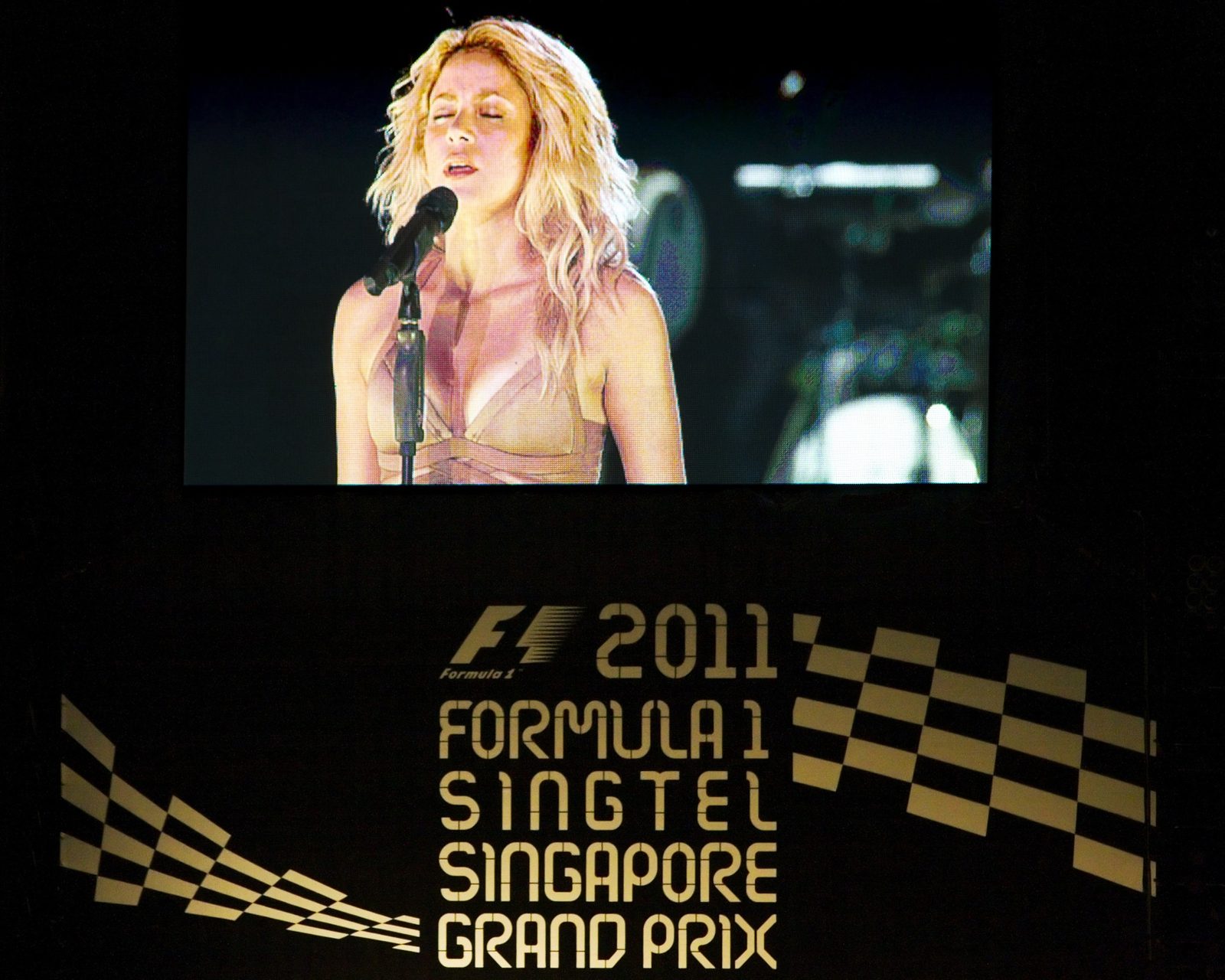
Photo: Matthias Rosenkranz / CC BY-SA 2.0 via Wikimedia Commons
At 10.25 on Sunday night, two and a half hours after the race started on the Marina Bay street circuit, Lana Del Rey walked onto the Padang Stage for her first concert in Singapore. Nobody in the crowd had bought a Lana Del Rey ticket. They had bought a Formula 1 ticket, and she came with it.
That is the whole trick, and it explains why one of the most dependable places to see a global headliner in Southeast Asia is a motor race. Over three nights, 9 to 11 October, the Singapore Grand Prix put more than 30 acts on 10 stages: The Killers, Zara Larsson, James Arthur, Janet Jackson, the Singaporean Mandopop star JJ Lin and the HYBE boy group CORTIS among them. Organisers counted 301,294 people over the weekend, the second-biggest crowd since the race began in 2008, even with haze from Indonesian wildfires hanging over the city.
The Grand Prix can book like this because it is not really in the concert business. It does not need any one act to sell tickets, its costs are shared with the state, and its music budget is judged against tourism, not against the box office. Here is how the money moves, and what that does to who gets on stage.
The race ticket is the concert ticket
Start with the rule printed on the promoter's own lineup announcement: every ticket, from the cheapest walkabout pass to a hospitality suite, includes the performances in Zone 4, where the Padang Stage sits. A ticket for Zone 1 adds the Wharf Stage, where Janet Jackson played on Sunday. You need a ticket for the day of the show. That is the only condition.
The official ticket page shows what that bundle cost this year. A three-day seat in the Padang Grandstand was S$598, about $460, and sold out. Pit Grandstand seats were S$1,548. At the top, a three-day Sky Suite package was listed at S$10,669. All of them, at whatever price, got into the same field in front of the same stage.
For a fan, the maths is strange but simple. A Padang Grandstand pass worked out at roughly S$200 a night, and on the Sunday that night included James Arthur, Lana Del Rey and a Grand Prix. For the promoter, the maths is different: it has already sold the ticket on the strength of the race and the whole weekend, so no single artist has to carry their own sales. When The Killers last played the Padang Stage, the promoter says, they drew 60,000 people. Nobody had to check whether 60,000 Singaporeans would pay to see The Killers on their own.
Who pays for the stage
The race is expensive and the state pays most of it. When Singapore signed its current seven-year deal with Formula 1, covering 2022 to 2028, Minister for Trade and Industry Gan Kim Yong told Parliament in a written reply on 14 February 2022 that the race would cost an estimated S$135 million to S$140 million a year to stage, and that the government would co-fund 60 percent of approved costs.
The case for that money is tourism, and the government has put a number on it. In a later reply, on 2 August 2023, the ministry said the race had brought in more than S$1.5 billion in incremental tourism receipts and more than 550,000 unique international visitors since 2008. The Singapore Tourism Board holds the contract with the promoter, Singapore GP Pte Ltd.
Those figures do not break out the cost of the concerts, and neither the promoter nor any of the artists publishes a fee. What we can say is where the music sits in the plan. A three-day race weekend has long gaps between sessions and a crowd that is not all motorsport fans. The concerts fill the gaps and widen the crowd, and they run on a budget whose success is measured in hotel nights and flights, not in how many tickets Zara Larsson sold. A standalone promoter booking her into an arena has to make the show pay on the night. The Grand Prix only has to make the weekend pay for the country.
What that does to the lineup
Look at how the three nights were built and the logic shows. Friday on the Padang Stage was CORTIS at 7.30pm and JJ Lin at 10.30pm: a K-pop group with a regional following and the biggest Singaporean name in Chinese-language pop. Saturday leaned on rock and Western pop with Zara Larsson and The Killers after qualifying. Sunday put Lana Del Rey after the race. Each night pulls a different crowd into the same ticket.
The risk-free money also lets the race take chances a touring promoter might not. CORTIS debuted on 18 August 2025 with "What You Want", the third boy group from Big Hit Music after BTS and TOMORROW X TOGETHER, and their label said this was the group's first visit to Singapore. The promoter put their 50-minute set in front of a crowd it estimated at 60,000. A group 14 months into its career rarely gets a room that size on its own in a new country. Here, the stage came pre-filled.
The same goes for firsts. Lana Del Rey had never played Singapore, and she used the date to sing "White Feather Hawk Tail Deer Hunter", from her coming album Stove, in front of a race crowd. Last year's bill ran from G-DRAGON on the Friday to Foo Fighters on the Saturday to Elton John after the race on the Sunday. Go further back and the names explain the formula: Shakira in 2011, Calvin Harris closing 2017, Queen with Adam Lambert. There is always one act for the regional fans, one for the expats and the corporate boxes, and one legend for the Sunday.
Singapore has a second way of doing this
The Grand Prix is one half of a policy. The other half made headlines in 2024, when Taylor Swift played six nights at the National Stadium and nowhere else in Southeast Asia. Singapore's culture minister Edwin Tong told Parliament on 4 March 2024 that the tourism board had given a grant, and declined to name the sum, saying only that it was nowhere near the figures being floated. Thailand's then prime minister, Srettha Thavisin, had said publicly that Singapore paid $2 million to $3 million a show; Singapore never confirmed that. A day after Tong spoke, Prime Minister Lee Hsien Loong said the agencies had negotiated for Singapore to be her only stop in the region.
The two methods are different tools for the same job. The Swift grant bought exclusivity for one tour. The Grand Prix buys a guaranteed weekend every year: one contract, one date in the calendar, dozens of acts, all of it priced into a race ticket.
Other races have copied the second model. In the Gulf, the Abu Dhabi Grand Prix runs its Yasalam after-race concerts from 3 to 6 December this year, open only to race ticket holders. Lewis Capaldi, who played Singapore in 2025, and Zara Larsson, who played it last weekend, open the Abu Dhabi run on 3 December, with Imagine Dragons, The Chainsmokers and The Script to follow. For a certain kind of pop act, the F1 calendar has become a touring circuit of its own, paid for out of race budgets rather than ticket sales.
What it means for fans in the region
For anyone in Singapore, this is a good deal, and nobody should pretend otherwise: S$598 bought three nights on the Padang Stage, from CORTIS to Lana Del Rey, and a race.
For the rest of Southeast Asia, it is more complicated. Every headliner who comes to the region on a race fee is a headliner who did not need a promoter in Jakarta, Kuala Lumpur, Bangkok or Manila to take the risk of booking them. Lana Del Rey's first Singapore show was a triumph for Singapore. It also meant that, this October, the nearest Lana Del Rey show for a fan in Jakarta was a flight away and came with a car race attached.
The contract runs to 2028. When Singapore next decides whether to renew, the music will not appear as its own line in the figures Parliament sees. It should. A race that books 30 acts a year is, by now, one of the most important concert promoters in Asia, and it is worth knowing what that stage costs and who it leaves out.
Share this story