FeatureEva Waxenberg7 min read
Makaveli at 30 was the last album Tupac made. Since then, the vault has made him
Recorded in about a week in August 1996, out two months after his death. Six more albums came from his tapes, shaped by whoever owned them.
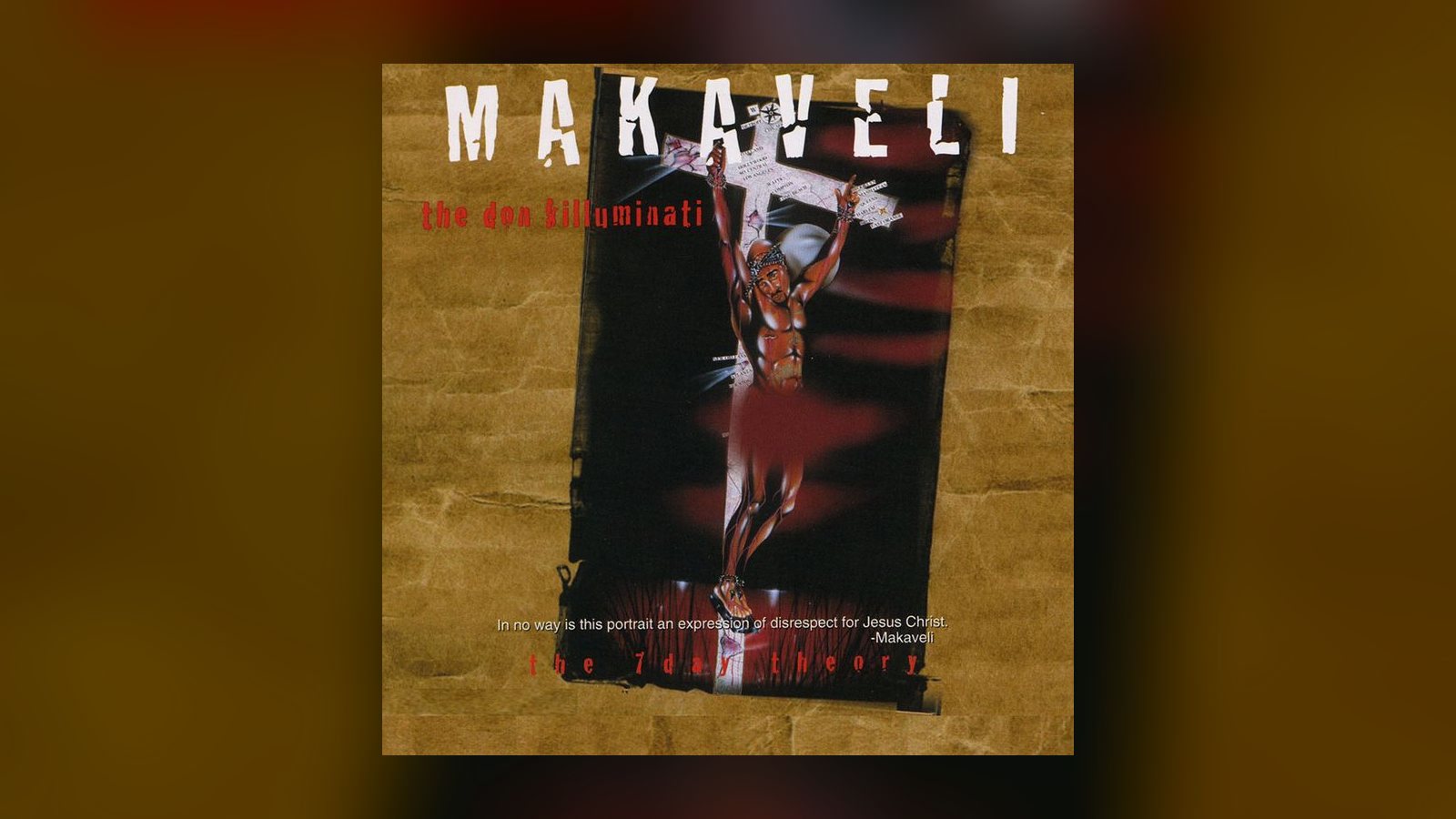
Artwork: Ronald "Riskie" Brent / Amaru Entertainment, under exclusive license to Interscope Records
Look at the bottom of the cover first. Under the painting of Tupac Shakur nailed to a cross, in small white type, is a line signed by the artist: "In no way is this portrait an expression of disrespect for Jesus Christ. -Makaveli." It is the only liner note most people remember from The Don Killuminati: The 7 Day Theory, and it is the last time a Tupac record spoke in his own voice about how it should be read.
The album came out 30 years ago today, on 5 November 1996, credited to Makaveli, a name he took from the Italian political writer he had read in prison. Tupac had been shot in Las Vegas on 7 September and died on 13 September, at 25. The record was not due until March 1997. Death Row Records moved it up by four months, and it opened at No. 1 on the US album chart with 664,000 copies in its first week.
Here is the part the anniversary pieces tend to skip. Makaveli is the last album Tupac finished. Every Tupac album since, and there have been six more studio albums alone, was finished by somebody else, from tapes he left behind. Who that somebody was depended on one question: who owned the vault. That question was settled in 1997 by his mother, Afeni Shakur, and the answer she won is still the rule posthumous rap runs on. The estate owns the tapes, so the estate decides who the dead artist becomes.
A week in Tarzana
Makaveli was made fast even by Tupac's standards. He cut it at Can-Am Studios in Tarzana, in the San Fernando Valley, and the core of it was done in about seven days in early August 1996, which is where the title comes from. He co-produced four of the 12 tracks. The beats are dark and roomy, the guests are mostly his own crew, the Outlawz, and the targets are named: Dr. Dre, Nas, Mobb Deep and others are called out across "Bomb First" and "Against All Odds."
Then there is "Hail Mary," a slow procession of a song that sounds like a funeral he planned for himself. It became a single in February 1997, five months after the funeral that actually happened.
The point is not that Makaveli is flawless. It is uneven, and its feuds have aged worse than its hooks. The point is that every choice on it, the sequencing, the alias, the crucifixion, the apology for the crucifixion, was his. Tupac released four studio albums in his lifetime: 2Pacalypse Now (1991), Strictly 4 My N.I.G.G.A.Z. (1993), Me Against the World (1995) and All Eyez on Me (February 1996). Makaveli is the fifth and final one where he decided what the listener heard.
Who owns a dead man's tapes
Tupac left far more music than albums. When he died, roughly 150 unreleased songs sat in Death Row's vaults. In 1997 his estate, run by his mother, reached a settlement with Death Row and its then distributor, Interscope, that confirmed the estate as the owner of that unreleased material, master recordings included. Death Row got one album's worth. The estate got the rest, and royalties on what came after.
Afeni Shakur was not a music executive. She was a former Black Panther who had defended herself in the Panther 21 conspiracy trial in New York in 1971 and was acquitted while pregnant with her son. In 1997 she founded Amaru Entertainment, named after him, to put out his music. Its first album, R U Still Down? (Remember Me), arrived on 25 November 1997 and reached No. 2. A decade later, when Death Row went bankrupt and the vault recordings were listed among its assets, she went to the bankruptcy court to stop them being sold.
She won the war that mattered. You can see it on the streaming listing for Makaveli itself, a Death Row album when it came out: today it carries the line "℗ 1996 Amaru Entertainment, Inc., under exclusive license to Interscope Records." The record that ended Tupac's life as an author now belongs to the company his mother built to continue it.
Six albums made from the tapes
Here is what that ownership produced. After Makaveli came R U Still Down? (1997), Still I Rise with the Outlawz (1999), Until the End of Time (2001), Better Dayz (2002), Loyal to the Game (2004) and Pac's Life (2006). Three of the seven posthumous studio albums, Makaveli included, went to No. 1 in the US. Tupac has released more studio albums dead than alive.
None of the six after Makaveli was sequenced by him. Most were built from verses recorded years earlier, dressed in new beats, new hooks and new guests. That is not automatically a crime. Some of those songs are loved, and his fans wanted every bar. But it means the Tupac of the 2000s was a collaboration between a dead man and his executors.
Loyal to the Game is the clearest case. Eminem wrote to Afeni Shakur asking to produce it, and she said yes. He built new music under verses Tupac had recorded between 1991 and 1994, changed the speed and pitch of Tupac's voice to fit, and cut and pasted his words so that Tupac seemed to say "G-Unit" and "Em," names that did not mean anything in rap when those verses were recorded. It went to No. 1 in the US in December 2004.
It also gave Tupac the biggest British hit of his career. "Ghetto Gospel," built on Elton John's 1971 song "Indian Sunset," spent three weeks at No. 1 in the UK in the summer of 2005. It is still his only UK No. 1. For a lot of listeners outside America, the first Tupac they heard was a song he never heard.
The template, 30 years on
Afeni Shakur died in 2016, and control of the estate has been fought over in court since. But the model she built is now simply how the industry handles a rapper who dies young: a family or estate holds the vault, a label distributes, and someone trusted, often a famous peer, is brought in to finish the songs.
Pop Smoke died in February 2020, and Shoot for the Stars, Aim for the Moon, completed with 50 Cent as executive producer, went to No. 1 that July. A week later Juice WRLD's Legends Never Die, released by his estate with Grade A Productions and Interscope, opened at No. 1 with 497,000 units, the biggest first week of 2020. More Juice WRLD albums have followed. The playbook is Amaru's, down to the guest verses.
There is a better version of that model, and it is also visible in Tupac's catalogue: release what the artist finished, and say so. When Mac Miller's family released Balloonerism in January 2025, they described it plainly as "a full length album that Malcolm created around the time of the release of Faces in 2014." That is the Makaveli standard. The record is the artist's, the estate is the courier. ADMC's view is that every posthumous release should tell listeners which kind it is, on the cover and in the credits, the way the Makaveli sleeve told them how to read its painting.
The man on the cross, still
This year closed one door on 1996. In August a Las Vegas jury convicted Duane "Keffe D" Davis of organising Tupac's murder, and in October he was sentenced to 40 years to life. Next August, Universal's Snoop biopic puts Afeni Shakur on screen, played by Cynthia Erivo, and Death Row itself is now owned by Snoop Dogg, Tupac's old labelmate.
So the story of the label, the killing and the mother is being told again. The music is the part still being written, and not by Tupac. Thirty years on, Makaveli is worth hearing as what it is: the last time 2Pac chose the songs, the order, the name and the picture. Put it on today and you are listening to the final draft. Everything after it is somebody else's edit.
Share this story