FeatureJane Shostak7 min read
Quebec built its music on French words. Its biggest export in years, from Saguenay, has none
Angine de Poitrine took four Grammy nods this week, from a city of 145,000 a five-hour drive north of Montreal. A scene report on the room that made them, and the rule they slipped.
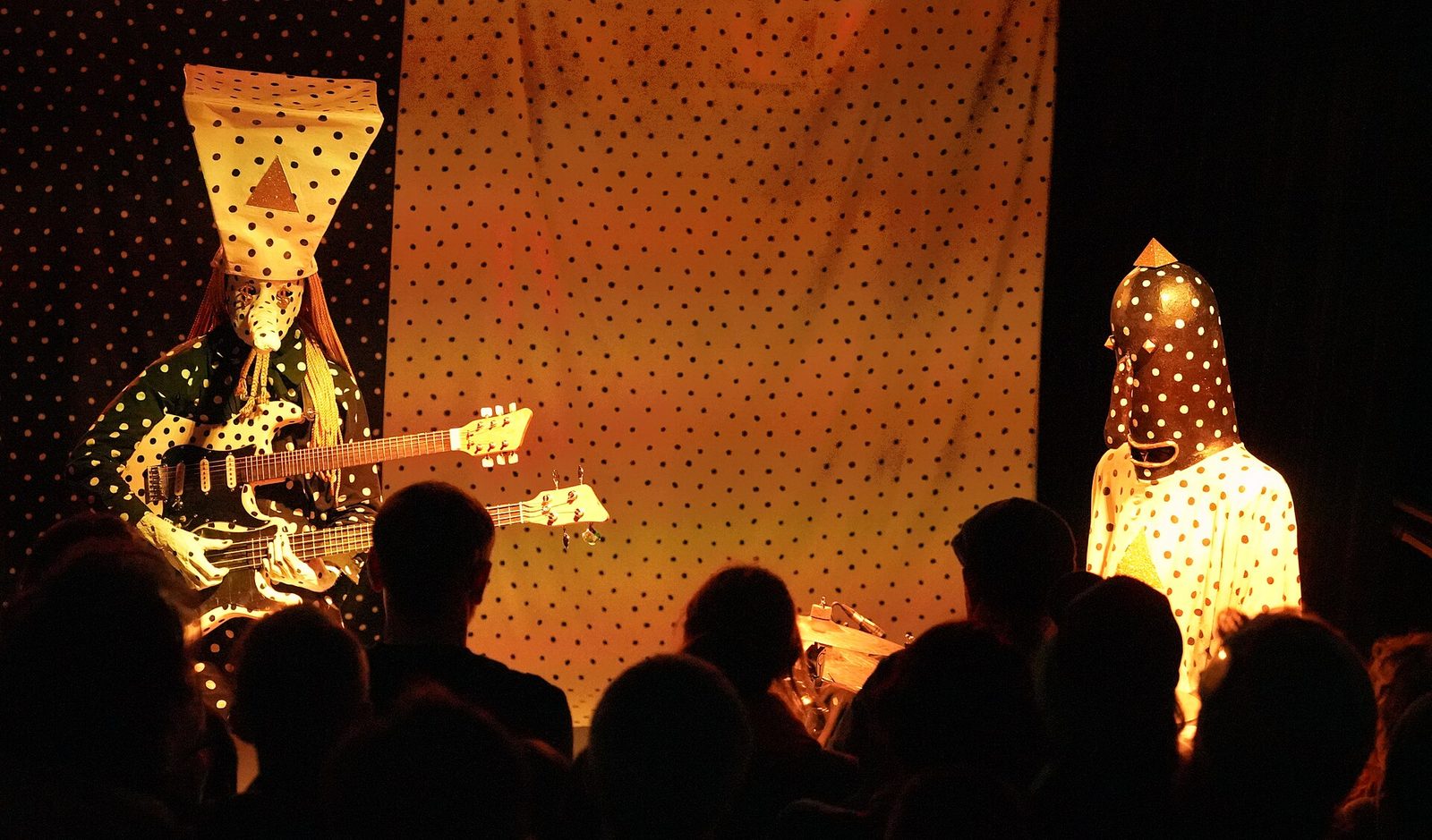
Photo: ReimsCroixRouge / CC BY-SA 4.0 via Wikimedia Commons
On 8 November, at the ADISQ gala in Montreal, Quebec's music industry gave its Song of the Year award to a song with no lyrics. "Fabienk" by Angine de Poitrine is quarter-tone guitar riffs and drums, with a few garbled syllables that are not French, English or anything else. The duo collected it in polka-dot costumes and papier-mâché heads, and instead of a thank-you speech they grilled a hot dog on stage.
The singer Mario Pelchat, one of the province's best-known voices, went to Facebook that night and called the win "la pire des insultes", the worst of insults, to the nominees who had actually written words. Eight days later the Recording Academy in Los Angeles answered him with four Grammy nominations: Best New Artist, Best Rock Album for Vol. II, Best Rock Performance for "Sarniezz" and Best Alternative Music Performance for "Fabienk". In Best New Artist they sit next to the New York band Geese.
Here is the argument of this piece. Quebec spent fifty years building a music system to protect French words, and its biggest international breakout in a generation has none. That is not an accident and it is not a fluke of a viral video. It is what happens when a small northern city keeps a room open for music that the system was never designed to sell.
Where Saguenay is, and why it is not Montreal
Saguenay is a city of 144,723 people (2021 census) at the head of a fjord, roughly a five-hour drive north of Montreal. It was stitched together in 2002 from Chicoutimi, Jonquière and La Baie, mill and smelter towns that grew up on aluminium and pulp. Almost everyone speaks French at home. Montreal is where Quebec music careers usually go to happen; Saguenay is where people come from.
The two founders of Angine de Poitrine, who perform as Khn and Klek de Poitrine, grew up in La Baie and have played together since they were 13. The band itself started as a joke in 2019, when they were booked at the same Saguenay venue twice in one week and played the second set in costume under a new name. Vol. 1 came out independently on 14 June 2024. For a while, that was a local story.
If you want a picture of La Baie, it is a pyramid. After the 1996 Saguenay flood tore through the borough, the local artist Jean-Jules Soucy built a 21-metre monument there out of about 3,000 yield signs, the Ha! Ha! Pyramid, a pun on giving way and helping each other. Look at the costumes: triangles on the hats, triangles on the drum kit. The band has never explained it in its own words, but nobody in La Baie needs it explained.
The rooms that did the work
The scene that made Angine de Poitrine is small enough to list.
There is the Centre d'expérimentation musicale, the CEM, a creation centre for experimental music that has run in Chicoutimi since 1982. Since 1989 it has staged a Festival des musiques de création, first at the Palace theatre in Jonquière, and today it runs a big recording room called the Studio Desjardins that doubles as a venue for the odd, the loud and the underground. Ottawa put $303,312 into the fourth phase of its renovations in 2023. In the year Vol. II went global, a government-funded room for avant-garde music in a smelter town had already been there for four decades.
There is Lutherie Le Breton in Alma, on Lac Saint-Jean, under an hour west. In 2023 Khn commissioned a double-necked instrument from the luthier Raphaël Le Breton: a Stratocaster-style guitar fused to a P-bass-style bass, with extra frets on both necks so that each octave has 24 notes instead of 12. That is the sound people mean when they say Angine de Poitrine sound "wrong" in a way they cannot stop replaying. It was built locally, by hand.
There is Planète Claire, an independent record shop on rue Racine, Chicoutimi's main street, run by Martin Desgroseilliers. The band played there for years before anyone abroad knew the name. After their appearance on Tout le monde en parle, Quebec's biggest Sunday talk show, in March 2026, the shop was swamped by messages from buyers in more than 100 countries, rationed the vinyl to two copies a head, and watched first pressings go for hundreds of US dollars on Discogs.
And there is La Noce, the summer festival Éric Harvey and Fred Poulin started in 2017, now held at La Pulperie, Chicoutimi's old pulp mill. On 2 July this year Angine de Poitrine opened it at home in front of about 4,500 people, many in homemade polka dots, throwing giant dice at the stage. When they played the small Café du Clocher this spring, fans queued outside.
Add the Jazz Fest Saguenay, which turned 30 this year, and the world-music festival that takes over the Chicoutimi waterfront every July, and you have a lot of stages for a city this size. None of them are built to launch export careers. They are built to keep people playing.
What it sounds like, if you have never heard it
Start with the KEXP session above, filmed at the Trans Musicales festival in Rennes, France, on 4 December 2025 and posted on 5 February 2026. It is the reason most people outside Quebec know the band.
It is math rock: odd time signatures, riffs that loop and mutate on a pedal, a drummer playing as if the bar lines were suggestions. If King Gizzard & the Lizard Wizard's microtonal records or Frank Zappa's knottier instrumentals live anywhere in your library, you already have the map. What makes it different is the tuning. The quarter-tones sit between the notes Western pop uses, so every hook sounds slightly sour and slightly sweet at once, closer to a Turkish or Arabic scale than to a rock band from Quebec.
Then there is the voice, or what passes for one. The vocals are sparse and distorted. On that March talk show the duo spoke an invented language, and in interviews a manager does the "translating". That joke is the whole point of this piece.
The rule they slipped
To see why a wordless band matters in Quebec, you need the rules. Since the 1970s, Canada's broadcast regulator has required French-language commercial radio to give at least 65% of its weekly popular music to French-language songs, and at least 55% between 6am and 6pm on weekdays. The ADISQ, the industry association behind the gala, was set up to champion Quebec's own, overwhelmingly French-language, record and concert business. Together they built one of the strongest local-language pop economies anywhere. They also built a ceiling. A francophone artist who fills arenas in Quebec usually means very little in Toronto, and less in Texas.
Language rules like this are everywhere in music; the Latin Grammys still count the words in a song to decide what is Latin. Angine de Poitrine walked under Quebec's ceiling. Without words, the radio quota does not quite know where to put them, but neither does a listener in Leeds or Tokyo need a translation. The numbers show which side opened up. Vol. II, out on 3 April 2026, entered the Billboard 200 at No. 44 when the physical edition landed in June, mostly on CDs and vinyl, with Vol. 1 right behind at No. 53. It reached No. 19 on the UK albums chart. In September it won the Polaris Music Prize, Canada's album-of-the-year award, and "Fabienk" also took Polaris's song prize. The ADISQ added eight Félix awards across its galas.
Pelchat had a point he did not quite make. In a province where chanson, the words-first song, sits at the heart of the culture, a Song of the Year that goes to an instrumental does change what the prize means. He later wrote that he regretted the word "insulte" while holding to the disagreement. But the evidence points the other way. A Quebec act got to the Grammys because its local scene was allowed to make something that did not have to clear the language test first. The CEM, a luthier in Alma and a record shop on rue Racine did not ask whether it would play on radio. Few music economies anywhere would have paid for that.
Why now, and what comes next
The timing matters. In an internet full of machine-made sound, a band that hand-builds its instruments and hand-paints its heads looked like the opposite, and people noticed: the KEXP session has since passed ten million views. But the moment came to a band that had been ready for years, because Saguenay had been paying for rooms like the CEM since before its members were born.
The 2027 world tour comes home where it should. Between dates from Australia to the UK, Angine de Poitrine play the Zone portuaire de Chicoutimi on 30 July 2027, a few minutes' walk from Planète Claire. The bigger question is what the next kid in La Baie learns from them. If it is "write in French and hope Montreal calls," nothing changes. If it is "build the weird thing, at home, and let the world come," Saguenay has a scene that could outlast its most famous duo, and Quebec has a reason to fund the strange rooms as hard as it protects the words.
On Grammy night, nobody will have to translate the music. Somebody may have to translate the speech.
Up next
The Latin Grammys decide what is Latin by counting words. Here is how the 60% rule works
Diljit Dosanjh plays the Latin Grammys on Thursday, yet his Punjabi verses could never compete there. A lyric count draws the line, not a beat or a passport.
Share this story