FeatureSamantha Lee7 min read
K/DA swapped its singers and kept its name. Pop has run that deal since the Archies
Five of the seven named cartoon pop stars at the Worlds final in Brooklyn had new voices. From Bombay playback to Seoul's PLAVE, the voices only win when fans learn their names.
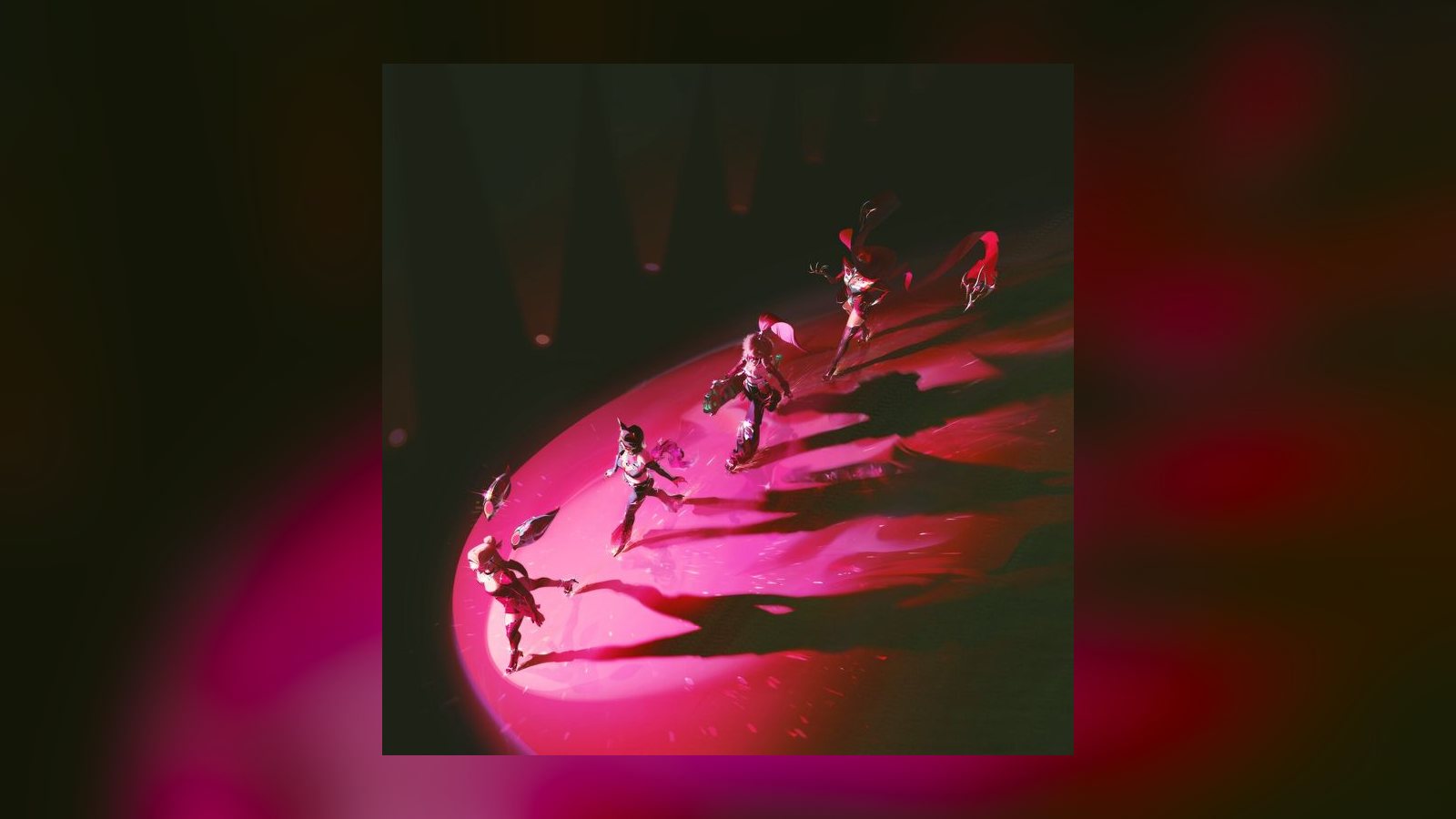
Artwork: Riot Games, Inc.
Yesterday afternoon at Barclays Center in Brooklyn, before Gen.G and Bilibili Gaming played the final of the League of Legends World Championship, two pop groups that do not exist opened the show. K/DA, Riot Games' four-woman K-pop act, and True Damage, its five-piece hip-hop crew, performed as animated champions from the game, with real singers behind them.
Count the voices and something odd shows up. Of the seven characters with a singer named for this year's show, five had a different singer from the one who launched them. Evelynn and Kai'Sa, first sung by Madison Beer and Jaira Burns, are now Sophie Powers and Mimi Webb. Senna, Qiyana and Ekko, first sung by Keke Palmer, Becky G and Thutmose in 2019, are now Coco Jones, Sofía Reyes and Vic Mensa. Only Soyeon of i-dle, who sings Akali in both groups, and her bandmate Miyeon, who sings Ahri, have been there from the start. The names on the screen did not change at all.
That is not a glitch in virtual pop. It is the point of it, and it is the oldest deal in the record business: the company owns the face and rents the voice. The cartoon only makes the deal honest. What a century of pop says, from 1969 New York to 1950s Bombay to Seoul now, is that the deal changes only when fans decide the voice has a name worth knowing.
A band that could not argue back
In early 1967 Don Kirshner, the man who picked the songs for the Monkees, released "A Little Bit Me, A Little Bit You" as a single without the approval of Columbia Pictures. The band had been pushing to play on their own records and choose their own singles, and the release cost Kirshner the job. His next act was a cartoon: the Archies, from the comic book and the Saturday morning show, a group in which the only people to manage were studio musicians.
"Sugar, Sugar", written by Jeff Barry and Andy Kim, went to No. 1 on the Billboard Hot 100 on 20 September 1969 and stayed four weeks. It held the top of the UK chart for eight, and it ended 1969 as the year-end No. 1 in both countries. The lead voice belonged to a session singer, Ron Dante, multitracked with Toni Wine and Andy Kim. The sleeve said "The Archies". The drawing took the bow.
Twenty years later the same arrangement, with real faces instead of drawings, blew up. Milli Vanilli won the Grammy for Best New Artist in 1990, and when it came out that the two men on the cover had not sung on the record, the award was withdrawn. The audience felt robbed. Put the deal inside a cartoon, though, and nobody feels lied to, because nobody thought Archie Andrews was real. That is the trick virtual pop inherited.
K/DA was built to be recast
K/DA arrived on 3 November 2018 at the Worlds opening ceremony in Incheon, South Korea, where Beer, Burns, Miyeon and Soyeon sang "POP/STARS" while augmented-reality versions of their characters danced beside them. The song topped Billboard's World Digital Song Sales chart that month, and its video has passed 640 million YouTube views.
Read the credits and you can see the plan. The singers are always "featuring": the act is K/DA, and the members are Ahri, Akali, Evelynn and Kai'Sa. By the 2020 EP All Out, Evelynn already had a second voice in Bea Miller and Kai'Sa had one in Wolftyla. The 2026 recast that read as a shock to some fans in October was the third set of voices for those two characters, not the first change. Riot has not explained why Beer and Burns are not on "FIRESTARTER", so we will not guess.
What Riot sells is the character, in the game, as a skin, on a poster, and the character does not age, tour on its own schedule, sign with another company or renegotiate. In our view, that is why the voices sit in brackets. It also explains why the singer who walked into K/DA with the biggest name of her own, Madison Beer, is the one whose career runs clearly separate from it. For everyone else, the character is the louder name.
Bombay worked this out first
If you grew up in South Asia, none of this is new. Hindi cinema has run on the same split since the 1930s: the star mimes on screen, the playback singer records in a studio, and for years the singer was treated as a technician. The face sold the ticket.
The playback singers did not stay in brackets, because their audience learned their names. Lata Mangeshkar, the defining voice of Hindi film song for half a century, refused to sing "Rasik Balma" live at a Filmfare ceremony in the late 1950s to protest that the awards had no category for the people actually singing the songs. Filmfare created one, and in 1959 she was its first winner, for "Aaja Re Pardesi" from Madhumati.
For most singers the fight over money took far longer. Only when India's Copyright (Amendment) Act of 2012 gave performers a legal right to royalties did singers as a group get a share of what their recordings earned in commercial use, and the Indian Singers' Rights Association, the first copyright society registered after that change, had Mangeshkar as its founding chair. From the protest at the awards to the law took more than half a century. In our reading, every step came from the same leverage: millions of listeners who knew exactly whose voice was coming out of the hero's mouth.
Two endings: Miku and PLAVE
Japan ran the experiment to its far end. In 2007 Crypton Future Media released Hatsune Miku, a singing-synthesiser voice built from samples recorded by the voice actress Saki Fujita, with a turquoise-haired character on the box. Soon after, people were posting Miku songs to the video site Niconico. By 2011 she had an estimated 100,000 songs to her name, she opened for Lady Gaga's ArtRave tour in 2014, and she played Coachella in 2024. Miku is the most famous voice in virtual pop and almost nobody outside Japan could name Fujita. Here the voice was not rented to a company. It was handed to everyone, and the fame went to the character and the crowd of producers writing for her.
Seoul ran it the other way. PLAVE, five animated men from the company VLAST, debuted on 12 March 2023. The members are real, anonymous people who sing, rap and dance live through motion capture, and three of them, Yejun, Noah and Eunho, carry producer credits. In 2024 "WAY 4 LUV" won on Show Champion and Show! Music Core, the first time a virtual group had won a Korean music show, and in November 2025 they sold out two nights at Gocheok Sky Dome, Seoul's baseball stadium. VLAST's chief executive has said in interviews that this line-up cannot change.
That is the opposite promise to K/DA's. PLAVE fans do not know their members' legal names, but they know their voices, their jokes on livestreams and their writing credits, and they pay for those specific people. The avatar is a mask over a person the fans have chosen, not a costume any singer can wear. Gorillaz, where Damon Albarn and Jamie Hewlett own the drawings they perform behind, got there in 2001 by a different road: the humans own the cartoon.
The question to ask after Brooklyn
There is nothing scandalous about how Riot runs K/DA. Mimi Webb, a BRIT-nominated singer from England, and Sophie Powers, a 22-year-old from Canada, were hired openly and are named on every credit, which is more than Ron Dante got in 1969. It is a fair business, and the "FIRESTARTER" video's 15 million views in its first two days show the audience did not leave.
But a K/DA fan watching yesterday's ceremony holds the only lever the singers have. The Archies' listeners never asked who was singing, and the voice stayed a session fee. Lata Mangeshkar's listeners asked, and the voice got an award category, then a royalty, then a law. If the people who scream for Kai'Sa at Worlds start to scream for Mimi Webb, the next recast gets harder to make. If they don't, the next singer will be in brackets too, and the drawing will keep the name.
Up next
Sade enter the Rock Hall as four people. The sound R&B copies was built by all four
Snoh Aalegra's Legendary Love is out today. From Maxwell to Sweetback, the Sade sound has always travelled through the band's players, not just the voice.
Share this story