FeatureRonit Singh7 min read
The Premier League gave India a sitar. Indian stadiums already sing in their own words
The Premier League's Indian anthem adds sitar, sarangi and bansuri. Chepauk, Kochi and Bengaluru show that a crowd makes a song its own with words, not instruments.
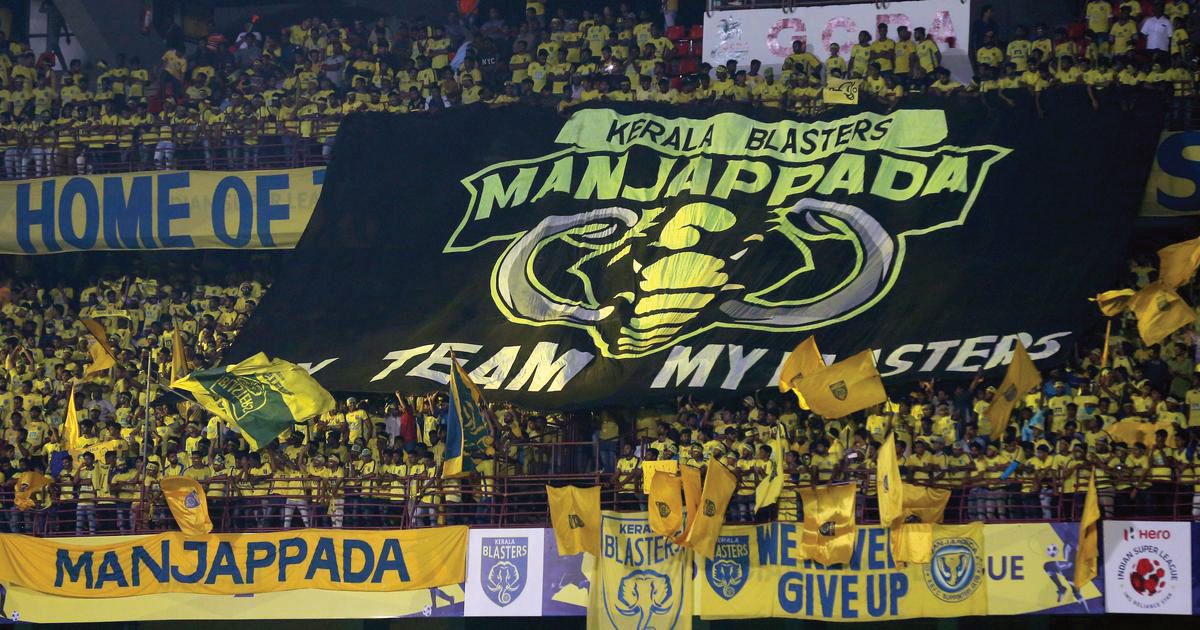
Photo: Manjappada TV / CC BY 3.0 via Wikimedia Commons
On the eve of the 2026/27 season, the Premier League gave India something it has never given any other country: its own version of the league anthem. Delhi guitarist and producer Dhruv Visvanath reworked Dave Connolly's theme in under two weeks, threading sitar, sarangi and bansuri through the melody and bending the strings into an Indian swing. The league, which opened an India office in April 2025, framed it as a version fans here could call their own.
It is careful, good-natured work, and Visvanath said the right thing about it. He told Rolling Stone India the job was "less about how India fits into that, but how that fits into India." Connolly said he had dreamed of making something that, like football, "can be handed over."
Here is the catch. Indian crowds have been taking songs that were never written for them and making them theirs for years, and they have never once done it with a sitar. They do it with words. A stadium song in India belongs to the crowd when it is sung in the crowd's own language about the crowd's own city, and the instruments are almost beside the point. The Premier League changed the timbre. Indian terraces change the lyric.
What Chepauk taught everyone
Start with the most successful sports song this country has produced. "Whistle Podu" was written in 2008 by the Chennai duo Aravind Murali and Jaishankar Iyer, made for YouTube rather than for a stadium, and it took off with Chennai Super Kings fans during the 2009 season before the franchise adopted it as its anthem. Its title is a Tamil instruction: blow the whistle. Anyone who has sat in a Tamil single screen on a star's release day knows exactly what that whistle means. It is the sound a hall makes when the hero walks in.
So the song did not need to tell Chennai it was Chennai's. It borrowed a ritual the city already performed and put a team's name on it. The fan club the franchise later formalised, in January 2016, is called the Whistle Podu Army. The 2026 version, released on CSK's own channel, still turns on that same Tamil phrase.
Kolkata Knight Riders, who say they were the first IPL side to launch an anthem, took the same route through Bengali. "Korbo Lorbo Jeetbo Re", scored by Vishal-Shekhar with Usha Uthup among the voices, is three Bengali verbs: we will do it, we will fight, we will win. A Hindi version would have travelled further on paper. It would not have become a stand at Eden Gardens.
The proof that KKR understands this came this year. For the 2026 IPL season, the franchise translated the slogan for its away cities: Marathi on the bus in Mumbai, Tamil in Chennai, Gujarati in Ahmedabad, Telugu in Hyderabad, Chhattisgarhi in Raipur, Hindi in Lucknow and Delhi. When an Indian sports brand wants to say "this is yours too" to a new city, it does not add a sarangi. It learns the words.
The tune can come from anywhere
Football makes the point more sharply, because Indian football fans steal melodies shamelessly and still end up with something nobody could mistake for Anfield.
Manjappada, the Kerala Blasters supporters' group, began on 27 May 2014 as a Facebook page run by three fans. By the 2015 season the club was averaging around 52,000 a game in Kochi, which Wikipedia's record of the group lists as the highest average in Indian Super League history. Their official anthem, released in August 2017, opens on "Dale Dale Dale", a chant phrase straight out of South American terraces. Nobody in Kochi thinks it is foreign, because the chant that sits beside it is in Malayalam: "Niram Manjayaane", the colour is yellow. On 11 December 2022, against Bengaluru FC, they unfurled a tifo 103 metres long and 11,752 square feet in area.
Across the rivalry, Bengaluru FC's West Block Blues do the same thing with Kannada. In 2017, coordinators told the club's site that they had built a chant for the forward Miku to the tune of "Huttidare". That is "Huttidare Kannada Nadalli Huttabeku", written by Hamsalekha for the 1993 film Aakasmika and sung on screen by Rajkumar: a song whose whole subject is the pride of being born Kannadiga. A Venezuelan striker got serenaded with the closest thing Karnataka has to an unofficial anthem. That is localisation done properly, and no consultancy designed it.
In Kolkata, East Bengal fans adapted Liverpool's "Allez Allez Allez" and kept singing Bengali chants of their own beside it, while Mohun Bagan's supporters have "Amader Surjo Merun": our sun is maroon. The pattern across all of them is the same. Indian crowds will take a tune from Buenos Aires, Merseyside or a 1993 Kannada blockbuster without a second thought. What they will not do is sing someone else's words.
The sitar is the sound of being looked at
Which brings us back to the instruments. Sitar, sarangi and bansuri are beautiful, and Visvanath is a player who knows exactly what to do with them. But as a shorthand, they are the sound of India as heard from outside: the palette a global brand reaches for when it wants a viewer abroad to understand, within two bars, that the scene has moved to India. Rolling Stone India reported that Connolly knew the obvious risk was clichéd sounds, and that he dug through contemporary Indian hip-hop and pop before deciding the sound of India now has far more to draw on than the traditional signifiers. The finished version still landed on the three instruments a stranger would pick.
Visvanath's own line about the result is the most honest review it will get. He said this version "sounds exactly like a song fit for a wedding". That is not a criticism. Weddings are where India actually uses its classical signifiers, as ceremony. A football crowd is something else: a few thousand people who need a line they can shout together after midnight in Mumbai, when Chelsea concede.
None of this means the Premier League got it wrong. It made an instrumental, and an instrumental cannot have lyrics. The fairer point is that the version which would truly belong to India is not one a league can commission. It is the one that appears when a stand in Kochi or Bengaluru decides that a Premier League tune works for them, and writes their own words over it.
The one exception proves it
There is a pan-Indian sports song that every stadium sings, and it is in Hindi: "Chak De India", from the 2007 film, composed by Salim-Sulaiman, written by Jaideep Sahni and led by Sukhwinder Singh. It plays at cricket grounds, hockey matches and school sports days in every state, in a country where Hindi is not every fan's first language.
But look at why it works. It arrived inside a film about a women's hockey team built from players of different states and languages, coached into one side. The song came with a story about belonging, and the story is the thing being sung. Its title is a Punjabi expression of encouragement, not a Hindi one. Even the exception travelled on words, and on the idea that a crowd from everywhere could share them.
So here is the test for anyone, from a global league to an Indian franchise, who wants a song Indian fans will claim. Ask what the crowd would shout, in the language they argue in, about the place they come from. Get that right and the instruments can be anything: a Tamil street band, a Liverpool chant, an orchestra in London. Get it wrong and the sitar just tells them who you think they are.
The real Indian version of the Premier League anthem probably already exists. It is in a watch party somewhere in Kozhikode or Shillong, half in English, half in something else, and the league has not heard it yet.
Share this story