FeatureNatalia Pedroza7 min read
The stadium residency only works where the fans already live, and Latin pop proved it
Shakira's Madrid stadium closes on 11 October. With Bad Bunny's San Juan run, it shows a residency is fair when it goes where the audience lives.
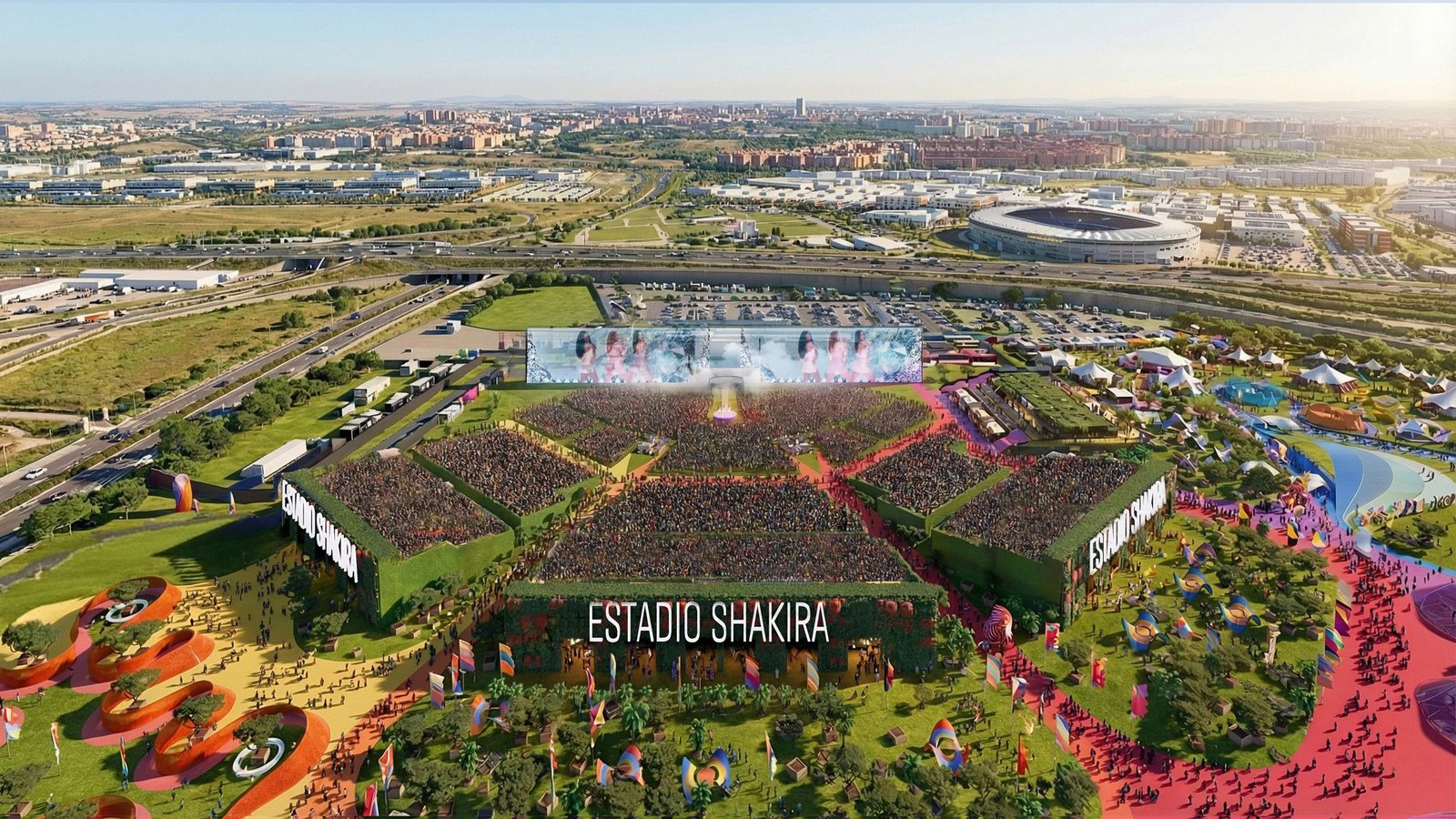
Render: BIG (Bjarke Ingels Group) via Dezeen
On Sunday 11 October, Shakira plays the last of twelve nights in a stadium that did not exist in the spring. It sits on the Iberdrola Music site in Villaverde, on Madrid's southern edge near Getafe, holds more than 50,000 people a night, and was designed by Bjarke Ingels Group, the Danish architects who built Adele's pop-up arena in Munich two summers ago. When it comes down, roughly 650,000 tickets will have gone through its gates.
The run has been sold as the future of touring: one city, one custom building, the fans come to you. The usual objection is just as familiar. A residency makes the audience do the travelling, prices out the fans who cannot fly, piles the cost onto one neighbourhood and leaves every other city with nothing.
Both sides are arguing about the wrong thing. Whether a residency is a better way to tour depends on where it lands, and Latin pop's biggest stars have spent two years showing the industry the answer: a residency is fair when it goes where the audience already lives. Bad Bunny in San Juan got that exactly right. Shakira in Madrid mostly did. Adele in Munich, the show everyone cites as the model, did not.
Munich was the version the critics are right about
Start with the template. Adele played ten nights at a temporary arena on the Munich trade fair grounds between 2 and 31 August 2024, with about 74,000 people a night and more than 730,000 in total. They were her only European dates of that era. Munich's own economic officials estimated that somewhere between 40 and 70 percent of the crowd came from abroad.
That is what a destination residency looks like when it is built for the travelling fan. Munich was not where Adele's audience lived; it was a place to put a venue big enough for a continent. Everyone who loved her in Madrid, Warsaw or Dublin got the same offer: a flight, a hotel, a ticket.
The climate cost of that model is not a guess. When Massive Attack staged ACT 1.5 in Bristol in August 2024 with researchers from the Tyndall Centre for Climate Change Research, the 5 percent of the audience who flew in were responsible for 64 percent of the event's greenhouse gas emissions. Tellingly, that show had offered a localised presale and chartered trains. The band's Robert Del Naja put it bluntly in the university's announcement: "If fans are encouraged to tour the world to see their favourite artists this sector can simply forget about hitting any emissions reductions targets, let alone Paris 1.5 compatibility."
So the critics have a point. A residency that pulls half its crowd across borders moves the cost of the tour, in money and in carbon, from the artist to the fan. If that were the only kind of residency, the case against would win.
San Juan wrote the rule
It is not the only kind. In 2025 Bad Bunny played 31 shows at the José Miguel Agrelot Coliseum in San Juan, the 18,500-capacity arena Puerto Ricans call El Choliseo, between 11 July and 20 September. He called it No Me Quiero Ir de Aquí, "I don't want to leave here", and he built the ticketing around the title. The first nine shows were sold only to Puerto Rico residents, in person, with proof of residence. The final night was registered for residents too.
The rest of the world did come, and spent. Estimates of what the run brought the island range from at least $176.6 million, by a University of Puerto Rico economist, to around $200 million in visitor spending, by the island's tourism body. More than half a million people saw it. But the first claim on those seats belonged to the people the songs were about.
That is not a marketing detail. Debí Tirar Más Fotos, the album the residency celebrated, is a record about holding on to a place while outsiders price you out of it. Its sharpest song names the fear directly.
A residency that sold every seat to whoever could fly in first would have contradicted "LO QUE LE PASÓ A HAWAii" from the stage. Bad Bunny made the ticketing match the songs, and in doing so he answered the strongest objection to the whole format: the home crowd goes first, everybody else after.
Madrid is a Latin city now
Which brings us back to Villaverde, and to the question of why Shakira, a Colombian who lived in Barcelona for over a decade, ended a 126-show world tour in Madrid. The tour opened in Rio de Janeiro on 11 February 2025 and spent most of its first year in the Americas, setting a Guinness World Record as the highest-grossing Latin tour ever with $421.6 million from its first 86 concerts. The fans in Bogotá, Buenos Aires and Mexico City had already had their nights. Madrid was the finale, not a replacement.
And Madrid is not Munich. The Madrid region is home to 1,038,671 people born in Spanish-speaking Latin America, according to Spain's national statistics office, about one resident in seven. In 1999 the figure was 81,552. The four biggest groups are Venezuelans (184,387), Colombians (180,983), Peruvians (150,590) and Ecuadorians (136,309). For a Colombian pop star, that is one of the biggest communities of her compatriots in Europe.
Shakira has said as much. Announcing the guests for the run on Instagram on 8 September, she wrote: "Porque España es latina. América es latina." Spain is Latin, America is Latin. In an opinion piece she wrote at the end of August, she explained that she picked the city because Latin immigration there is celebrated rather than merely tolerated. The guest list made the same point on stage: Spaniards such as Amaia and Guitarricadelafuente next to the Argentine singer Nathy Peluso and the rapper Louta.
The numbers back her up. Projections for the run had roughly half the audience arriving from outside the Madrid region, but only about one in five from outside Spain. Compare that with Munich's 40 to 70 percent from abroad. Four in five of Shakira's fans were expected to come from inside Spain, in a country whose largest Latin American community lives a metro ride from the stadium. Bad Bunny's ten nights at the Metropolitano stadium, between 30 May and 15 June this year, played to the same city. That is 22 Madrid stadium nights in one year for two Latin artists, more than a million tickets in a city that, 25 years ago, had fewer Latin American-born residents than one Metropolitano weekend holds.
Where Madrid fell short
The Madrid run still missed the part of the San Juan model that matters most. Tickets went on sale in March through presales for registered fans, a bank's music programme and the promoter, then general sale. We could find no allocation held back for the people of Villaverde or Getafe, who carried the cost of the month: residents' groups have complained of closed motorway access, rerouted buses and rehearsal noise late into the night.
That is the fix, and it is cheap. A slice of every residency's first sale ring-fenced for people with a local postcode. A share of the run, as in San Juan, sold in person. These are small changes on a 650,000-ticket run, and they turn "the city hosts the show" into "the show is for the city".
The new map
The tour will not disappear. Most artists cannot fill a stadium twelve times in one place, and for them going city to city is still the only way to reach anyone. But for the handful who can, the residency is clearly where things are heading, and the argument should move on from whether to do it to where.
Latin pop has drawn that map first because its audience moved before the industry did. A million Latin Americans in Madrid, a Puerto Rican diaspora that flew home for a summer, a Colombian star who chose the city where her compatriots now live. The residency that works does not ask fans to come to the artist. It goes to the fans who were already there, and lets them in first.
Share this story