ListEva Waxenberg9 min read
Thirteen records where the room did half the work, from a Toronto church to a phone
Cowboy Junkies cut The Trinity Session in a Toronto church 39 years ago this week. From Kingston to Chennai to a phone, these rooms made the record.
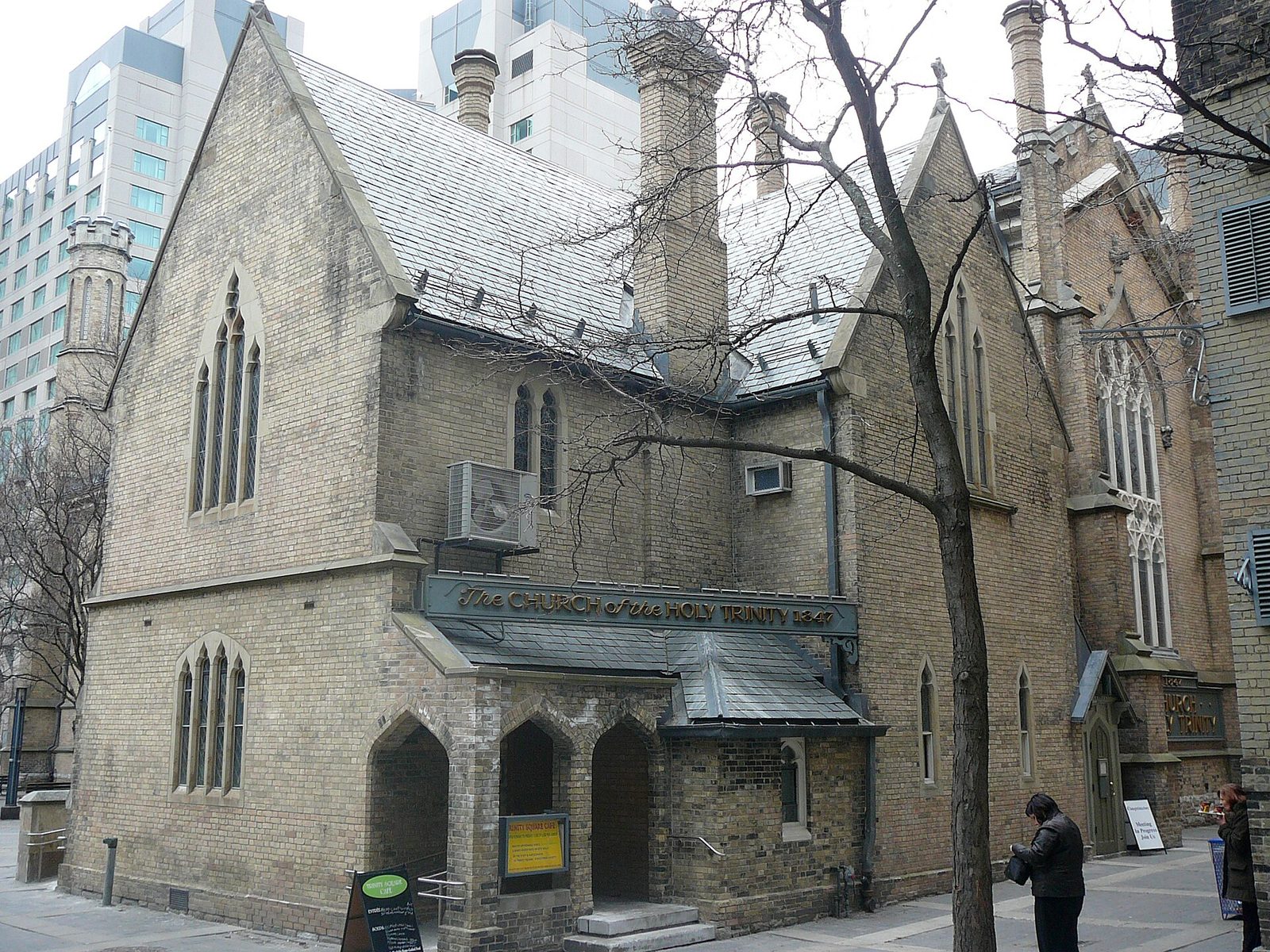
Photo: Steve Harris from Toronto, Canada / CC BY 2.0 via Wikimedia Commons
On 27 November 1987, the four members of Cowboy Junkies and a few friends carried their gear into the Church of the Holy Trinity, an 1847 brick church tucked behind the Eaton Centre shopping mall, and stood in a circle around one microphone. By the end of a single long day they had most of an album. They called it The Trinity Session, and the reason it still sounds like nothing else is not the band. It is the building: every brush on a snare hangs in the air of that nave for a second longer than any studio would allow.
That was 39 years ago this week, and it is a good day to say something bedroom pop fans are rarely told. The music you love was not made small because its makers could not afford a real studio. It belongs to a long line of records where the room did half the arranging: a stairwell, a backyard shed, a swimming pool, a hunting cabin, a hotel conference room. Nobody built any of them for music. That is exactly why they sound the way they do, and why studios and producers have spent decades trying to fake them.
Here are thirteen, in the order they were made. Our picks, each with the room that made it.
1. Led Zeppelin, "When the Levee Breaks" (1971)
Led Zeppelin rented Headley Grange, a draughty old house in Hampshire, England, and parked the Rolling Stones' mobile recording truck outside. John Bonham's drum kit went into the entrance hall, and the microphones went up the stairwell above it. What came back is the biggest, slowest drum sound in rock, a sound no booth could make because no booth has three floors of stairs over it. Fifteen years later the Beastie Boys looped it for "Rhymin & Stealin", and hip-hop producers have been borrowing that hallway ever since.
2. Junior Murvin, "Police and Thieves" (1976)
In the early 1970s the Jamaican producer Lee "Scratch" Perry built the Black Ark behind his family home in Washington Gardens, Kingston: a small backyard studio with modest gear he pushed far past what it was made for. Junior Murvin's falsetto protest song came out of that room in 1976, wrapped in Perry's murky echo and phasing, and The Clash covered it a year later in London. Perry shut the Black Ark at the end of the decade and it later burned down. Producers have chased its haze ever since.
3. Bruce Springsteen, "Atlantic City" (1982)
In January 1982, Bruce Springsteen sat in the bedroom of a rented house in Colts Neck, New Jersey, with a guitar, a harmonica and a Tascam four-track cassette recorder. He meant the tape as demos for his band. The band versions never matched it, so the label released the cassette, more or less as it was, as Nebraska. "Atlantic City" is the sound of one man and a carpet. Every lo-fi record you have saved on Spotify owes that cassette a thank-you note, whether or not its maker has heard it.
4. Cowboy Junkies, "Sweet Jane" (1988)
The Trinity Session, out of the church described above. Producer Peter Moore picked the Church of the Holy Trinity for its natural reverb and recorded the band around a single Calrec ambisonic microphone, a device that captures the whole space rather than any one instrument. Margo Timmins sang quietly because the room did the rest. Their slowed-down version of the Velvet Underground song became their signature, and it is the clearest lesson on this list: a voice that never pushes, set in a big room, sounds closer than one shouting in a small one.
5. A.R. Rahman, Roja (1992)
In 1989 A.R. Rahman, then a young Chennai session keyboard player, set up a studio in the backyard of his family home in Kodambakkam, the city's film district, and called it Panchathan Record Inn. Indian film music at the time was recorded with big orchestras in big rooms. Rahman worked in his own small one, layering synths and players one by one, and his first feature score, Mani Ratnam's Roja, came out of that era and rewired Indian film music. The backyard is still there; in 2005 he built AM Studios next to it for everyone else.
6. Sigur Rós, "Hoppípolla" (2005)
In 1999 the Icelandic band Sigur Rós bought Sundlaugin, a swimming pool built in the 1930s at Álafoss, in Mosfellsbær just outside Reykjavík, and turned the empty pool into a studio. Takk..., the album that gave the world "Hoppípolla" and a decade of nature-documentary trailers, was recorded mainly there, with orchestral parts added later at Abbey Road in London. Listen to how the song swells: tiled walls and a deep concrete basin are cruel to a fussy mix and generous to anything that builds.
7. Ali Farka Touré and Toumani Diabaté, In the Heart of the Moon (2005)
In July 2004, the Malian guitarist Ali Farka Touré and the kora player Toumani Diabaté sat down in a room at the Hotel Mandé in Bamako, overlooking the Niger river, and played. The core of the album came from three short sessions, with no studio booths between the guitar and the kora: just two players a few feet apart, listening across the room. It won a Grammy for best traditional world music album in 2006. You can hear the room in the lack of anything else: no polish, just two masters and the air between them.
8. Bon Iver, "Skinny Love" (2007)
In the winter of 2006, Justin Vernon drove to his father's hunting cabin in northwestern Wisconsin after a band and a relationship had both ended, and stayed until spring. Bon Iver's For Emma, Forever Ago was recorded there, mostly by Vernon alone, his falsetto stacked into a choir of one. The cabin's dead, wooden quiet is the record's silence. It came out on his own in 2007, and a whole wave of whispered, close-miked indie followed it.
9. Tame Impala, "Solitude Is Bliss" (2010)
Kevin Parker had been recording alone in cramped share houses in Perth when the band booked Wave House, a beach property near Yallingup in Western Australia, a few hours' drive south, in mid-2009. No internet, no phone reception, the ocean outside, and some parts recorded out on the balcony. Innerspeaker came out of it, and Tame Impala went back to the same house for parts of Currents. Parker has said the place shaped the record. He later bought it, which tells you how much.
10. Cigarettes After Sex, "Nothing's Gonna Hurt You Baby" (2012)
In April 2012, Greg Gonzalez talked a professor at the University of Texas at El Paso, his old school, into letting his band into the music building after hours. They set up in a four-storey stairwell. He had written the song only hours earlier. Nobody planned it as a release, but that stairwell's long, soft echo became the entire Cigarettes After Sex sound: slow, hushed, and huge around the edges. The song went on to clear 100 million plays, and the band has been chasing that staircase in proper studios ever since.
11. Steve Lacy, "Dark Red" (2017)
Here the room shrinks to the size of a pocket. Steve Lacy wrote and recorded "Dark Red" by himself in GarageBand on his iPhone, guitar plugged in through a small adapter, singing into the phone's own microphone. It came out on Steve Lacy's Demo in February 2017, went viral on TikTok four years later and turned Platinum. The phone's mic has its own room sound, close and a little boxy, and on "Dark Red" it is the reason the voice feels like it is right by your ear.
12. Clairo, "Pretty Girl" (2017)
Clairo wrote and produced "Pretty Girl" in GarageBand with a small keyboard, then filmed its video in her childhood bedroom on her MacBook's Photo Booth app and uploaded it to YouTube in August 2017. The bedroom is in the sound and in the picture: a thin, close vocal, a cheap keyboard tone, a girl lip-syncing at her laptop. That clip made "bedroom pop" a genre name people search for. It is also Springsteen's Nebraska with a webcam: a demo the world decided was the record.
13. Billie Eilish, "bad guy" (2019)
Billie Eilish and her brother FINNEAS made When We All Fall Asleep, Where Do We Go? in his small bedroom in the family house in Highland Park, Los Angeles. The close, almost whispered vocal that defines the album suits a room that size: there is nowhere to belt into, and nothing between her mouth and your ear. In January 2020 it won album of the year at the Grammys. The bedroom had beaten the big room on the biggest stage there is.
The room you can't buy
Look at what happened next to most of these rooms. Sigur Rós own their pool. Kevin Parker bought Wave House. Rahman's backyard grew a commercial studio. Plugin makers sell reverbs that try to copy churches and stairwells. Every room on this list was free or close to it until the record made it famous, and then it turned into a product.
That is the real lesson for anyone recording in their bedroom tonight. The sound that ends up mattering does not come from a famous room. It comes from the one you are already standing in, before anyone has worked out what it is worth.
Up next
Who the f*ck is Magdalena Bay?
They started with a YouTube series of tiny pop songs recorded in a Miami bedroom, and ended up opening for Charli xcx and Billie Eilish.
Share this story