ListJane Shostak8 min read
Twelve songs that carried chutney from the bride's room to the Skinner Park stage
Chutney began as songs Indo-Caribbean women sang to brides behind closed doors. It took 31 years for a woman to win its biggest crown. These songs trace the road.
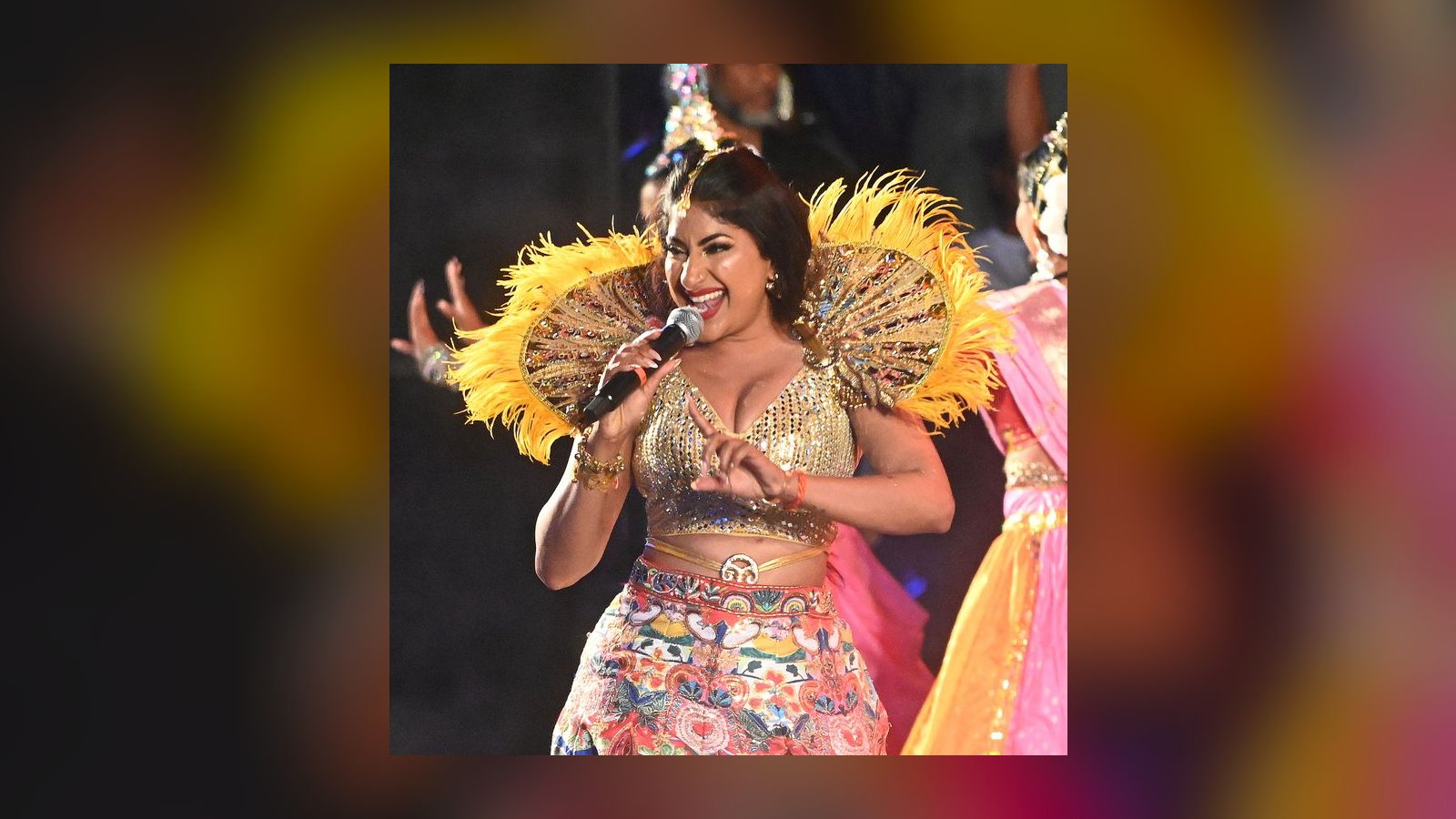
Photo: Ishamel Salandy / Trinidad Express
Some time after 1 a.m. on 9 February 2026, at Skinner Park in San Fernando, Trinidad, the organisers of the International Chutney Soca Monarch crowned a woman for the first time. Savita Singh, who had come into the competition as a wild card, took the title and its TT$400,000 prize with "The Ring". Rasika Dindial was second and Lady Lava third. The defending champion, Machel Montano, the biggest star in soca, came fourth.
So three women stood at the top of a contest that had been won only by men since it began in 1996. That is the strange part, because chutney was women's music before it was anybody's.
Between 1845 and 1917 roughly 144,000 indentured labourers sailed from India to Trinidad, most of them from the Bhojpuri-speaking country of what is now Bihar and eastern Uttar Pradesh. They brought the matikor, a night before a Hindu wedding when the women of the family gather with the bride and sing to her. Those songs were teasing, frank and often rude, sung by women for women, with no men in the room. Out of them, and out of the dholak drum that kept time, came chutney.
Here is our argument: the history of chutney is the history of men carrying women's songs into public, and of women slowly taking the microphone back. These twelve records, in order, show how that happened. With Divali, a national holiday in Trinidad and Tobago, falling on 8 November this year, it is a good month to press play on all of them.
1. Sundar Popo, "Nana and Nani" (1969)
Sundar Popo grew up singing at weddings with his parents in Barrackpore, in south Trinidad, and the promoter Moean Mohammed found him at a matikor. The song he recorded in 1969 tells of a grandfather and grandmother who are both fond of a drink, sung half in Bhojpuri and half in English over dholak and a calypso swing. It is a wedding-night song with the doors opened, and it made Popo, who died in 2000 aged 57, the man most people call the father of chutney.
2. Lord Shorty, "Indrani" (1973)
At the 1973 Calypso Monarch final in Port of Spain, the Afro-Trinidadian singer Garfield Blackman, Lord Shorty, came out for his second song wearing an orhni, the long shawl Indian women wear, with two Indo-Trinidadian musicians beside him on dholak and dhantal, the steel rod struck to keep time. "Indrani" is a love song to an Indian woman, and critics accused him of mocking Indian culture. The sound he was chasing became soca. Chutney soca starts here, with a man in a woman's shawl.
3. Babla & Kanchan, "Kaise Bani" (1980s)
Here the music crosses the ocean the other way. Babla and Kanchan, a husband and wife duo from Mumbai (Babla is the younger brother of the Bollywood composers Kalyanji and Anandji), recorded Sundar Popo's "Kaise Bani" and other Trinidad songs and toured them across the Caribbean, Fiji, Mauritius and South Africa through the 1980s. Kanchan's voice gave the diaspora its own songs back with a Bombay studio shine, and a song born at a Trinidad wedding became something Indian audiences heard too. She died in 2004, after four decades of singing with her husband.
4. Drupatee Ramgoonai, "Chatnee Soca" (1987)
Drupatee Ramgoonai, from Penal in south Trinidad, had won the local song category at the Mastana Bahar talent show in 1983 and 1984. In 1987 she released an album called Chatnee Soca, with songs in English and Hindustani, and gave the genre its name. Remember who had been singing chutney's ancestors for a century: women at weddings. The first person to put the word on a record sleeve was a woman too.
5. Drupatee Ramgoonai, "Roll Up the Tassa (Mr Bissessar)" (1988)
Then she made it a hit. "Mr Bissessar", with its call to roll up the tassa, the big Indo-Trinidadian kettle drums, was a Road March contender in 1988, which means it was in the running to be the song played most on the streets at Carnival. It made her a star across the Caribbean, and it made her a target: an Indian woman singing for a mixed crowd, about drums and dancing, scandalised conservative critics for years. In 2025 the state gave her the Hummingbird Medal (Gold).
6. Black Stalin, "Sundar Popo" (1995)
A measure of how far chutney had come by the mid 1990s: Black Stalin, one of the great Afro-Trinidadian calypsonians, won the Calypso Monarch in February 1995 with a song named after Sundar Popo. It is not a chutney song, and it is not in Hindustani. But a calypso king saluting the chutney king on the national stage was a statement about who belonged at Carnival, and the song was filed as chutney soca because of what it was about.
7. Sonny Mann, "Lotala" (1996)
The Chutney Soca Monarch competition began in the 1995 to 1996 Carnival season, and its first champion was Sonny Mann with "Lotala", which also reached the final of the main Soca Monarch. The contest turned a wedding music into a sport with judges, prize money and a big stage in San Fernando. It now costs more than US$1 million a year to stage. The list of champions over its first 15 years, from Mann to Rikki Jai to Ravi B, contains no women.
8. Machel Montano and Drupatee Ramgoonai, "Real Unity" (2000)
Machel Montano was already soca's golden boy when he put Drupatee on his album 2000 Young to Soca. "Real Unity" is a duet about exactly what it says, an Afro-Trinidadian man and an Indo-Trinidadian woman singing together, and it was one of the big soca hits of that year. Some radio stations banned it. A woman who had been told to stop singing in public was now on the hottest record in the country, and still being told off.
9. KI, "Single Forever" (2012)
By the 2000s the most famous strand of chutney was the drinking song, men singing about rum, and the competition reflected it. Kris "KI" Persad of the band JMC 3Veni came third in 2011 with "No More Rum Again", then won in 2012 with "Single Forever", taking 36,737 votes to Rikki Jai's 32,781. A winning song called "Single Forever", in a genre born on the night a woman gets married: the point of view had changed hands completely.
10. Machel Montano, Drupatee, Lady Lava, DJ Private Ryan and Jus Now, "Pepper Vine" (2025)
The year before the women's sweep, Machel Montano entered the Chutney Soca Monarch for the first time and won it, with a song built on DJ Private Ryan's Bombay Tea riddim. He did not do it alone. On stage at Skinner Park he had Drupatee and Lady Lava beside him. The biggest man in the music shared his winning stage with two women, and a year later one of them finished above him.
11. Rasika Dindial, "Pong D Damadol" (2026)
Rasika Dindial, from Kelly Village in Caroni, is the daughter of Basdeo "Lapoo" Dindial, a respected Indian classical musician, and she has been releasing chutney since "Golanee Ki Pool" in 1997. "Pong D Damadol", released in December 2025, brought her back to the Monarch after years away, and its official video has passed 3.6 million views on YouTube. She came second overall and won the new Traditional Chutney title, which means the judges named a woman the keeper of chutney's old sound.
12. Savita Singh, "The Ring" (2026)
The winner. "The Ring", written with Rishi Mahatoo, is about a married man who leaves his wedding band at home whenever he goes out to party. Singh has spoken about drawing it from the relationship talk she hears around her, and about wanting songs that are uplifting rather than degrading. Not everyone agreed with the judges: a former champion dismissed her as a cover singer, and many fans felt Dindial should have won. But listen to what the song does. It is a woman, in public, teasing a husband about marriage. That is a matikor song. It just has a crane, a drone light show and a crowd of thousands now.
The ring closes
Chutney spent fifty years becoming a public music, and almost every step of that was taken by a man carrying something women had made in private: Popo at the wedding, Shorty in the shawl, the rum songs and the prize money. Drupatee pushed the door in 1987 and took the abuse for it. What 2026 changed was not that women started singing chutney. They never stopped. It is that the biggest stage in the music finally scored them first, with a song about a wedding ring, in the week before Carnival, in front of thousands of people who would once have been sent out of the room.
Share this story